
A profitable company can still give its director an unpleasant surprise.
Suppose the year ends with £90,000 of taxable profits. The Corporation Tax bill isn’t simply 19% or 25%. Marginal relief may apply. The tax payment can also fall due three months before the Company Tax Return itself — while Companies House is working to a different filing deadline altogether.
That is why choosing an accountant for limited company work is about more than finding somebody to “do the year-end”.
A good accountant should help you understand what is due, when it is due, how the figures were reached and which decisions need attention before — rather than after — the accounting period closes.
This guide explains what a London limited-company director should expect from an accountant, the current 2026 deadlines and tax rules, what should be included in a quote, and the warning signs worth checking before you appoint a firm.
Quick answer
You are not generally required by law to appoint an accountant to run a UK private limited company. However, directors remain legally responsible for company records, statutory accounts, Company Tax Returns and Corporation Tax even when an accountant handles the work.
For most owner-managed companies, the useful question is therefore not simply “Do I need an accountant?” but which accounting, tax and reporting work would create enough value or reduce enough risk to justify professional support?
Key figures at a glance
For a typical private limited company, these are some of the numbers that matter most in 2026:
| Issue | Standard position | What can change it |
| Companies House annual accounts | Normally due 9 months after the financial year ends | First accounts and changed accounting periods have different rules |
| First Companies House accounts | Usually due 21 months after incorporation | The exact period depends on the first accounting reference date |
| Corporation Tax payment | Normally 9 months and 1 day after the Corporation Tax accounting period ends | Large and very large companies can have instalment-payment rules |
| Company Tax Return | Normally due 12 months after the Corporation Tax accounting period ends | First-year companies may need more than one return |
| Corporation Tax small profits rate | 19% for qualifying profits of £50,000 or less | Associated companies and short periods can reduce the thresholds |
| Corporation Tax main rate | 25% for profits above £250,000 | Marginal relief can apply between the limits |
| VAT registration threshold | More than £90,000 of taxable turnover | A forward-looking 30-day test also applies |
| Accounting records | HMRC generally requires relevant company records to be retained for 6 years from the end of the financial year concerned | Certain transactions, late returns or compliance checks can require longer retention |
The statutory accounts, Corporation Tax payment and Company Tax Return dates are separate deadlines. That distinction catches directors out surprisingly easily.
For the current official timetable, see the GOV.UK guidance on private-company accounts and tax returns.
What should an accountant for limited company work actually include?
For a straightforward owner-managed company, annual accounts and the CT600 are the starting point, not necessarily the complete service.
Your accountant may need to deal with several connected systems.
Companies House receives the company’s statutory accounts and confirmation statement. Companies House is concerned with the corporate register and statutory company information.
HMRC receives the Company Tax Return and deals with Corporation Tax. The CT600 is the principal return form within a Company Tax Return; supporting accounts, computations and supplementary information may also be required.
Depending on your business, your accountant’s work may also include:
- bookkeeping and reconciliations;
- Corporation Tax computations;
- identifying allowable expenditure and relevant capital allowances;
- VAT registration and VAT returns;
- payroll and PAYE reporting;
- dividend and director-remuneration records;
- director’s loan account monitoring;
- confirmation statements and other Companies House administration;
- management accounts;
- cash-flow forecasts and budgets;
- personal Self Assessment where the director’s circumstances require it.
Bloom Financials’ existing accounting service covers areas including bookkeeping, annual accounts and Corporation Tax, VAT, payroll, management reporting, forecasting and cloud accountancy.
The commercial point is simple: don’t compare accountants by monthly fee until you know what the monthly fee contains.
A £75 package and a £175 package aren’t comparable if one covers only annual compliance while the other includes bookkeeping, payroll, VAT, Companies House work and year-round advice.
You are still responsible even after appointing an accountant
This is one of the most important points in the whole decision.
GOV.UK states that a director can hire other people, including an accountant, to handle day-to-day work, but the director remains legally responsible for the company’s records, accounts and performance.
So an accountant should reduce your administrative burden. They do not transfer the director’s legal responsibility to themselves.
That has practical consequences.
If your year-end records arrive with the accountant two days before the filing deadline, saying “my accountant was dealing with it” does not automatically solve the problem. Companies House explicitly warns that relying on an accountant is not normally a successful ground for appealing a late-filing penalty.
A useful accountant therefore needs two things from you: good information and enough time to work with it.
The three year-end dates directors often confuse
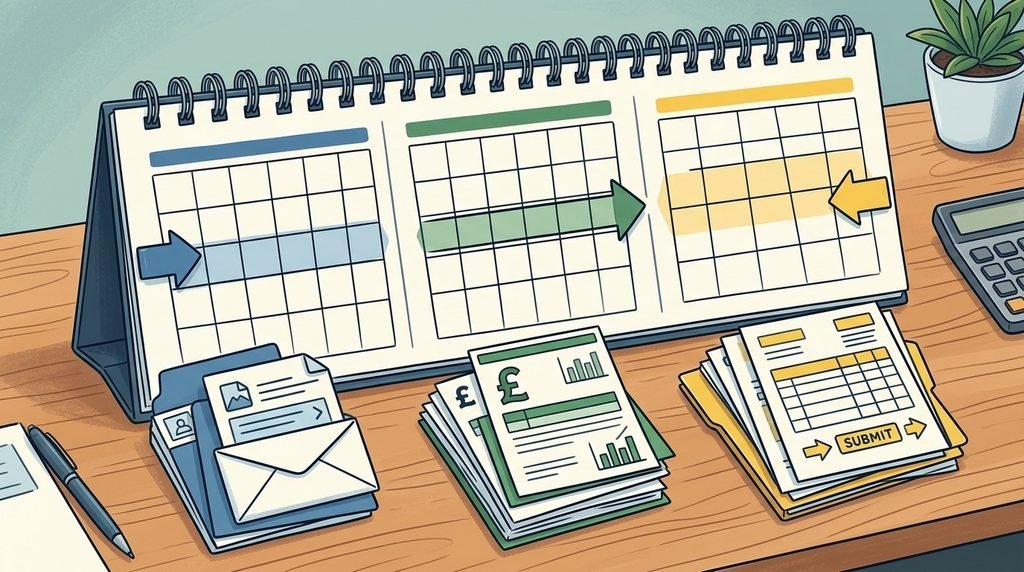
Take a fictional London consultancy with a 31 December 2026 year-end and a normal 12-month Corporation Tax accounting period.
Its standard timetable would broadly be:
| Obligation | Illustrative deadline |
| File annual accounts at Companies House | 30 September 2027 |
| Pay Corporation Tax | 1 October 2027 |
| File Company Tax Return with HMRC | 31 December 2027 |
Notice the awkward part.
The company normally has to pay its Corporation Tax before its CT600 filing deadline.
That means waiting until the Company Tax Return deadline to work out how much cash you need can be a costly approach to financial management.
An accountant who is only interested in collecting documents shortly before filing day may keep the company technically compliant, but the director may get very little help with the bigger problem: knowing the expected tax bill early enough to preserve the cash.
For growing companies, this is where management accounts and reporting can become more useful than a once-a-year set of accounts.
Worked example: £90,000 of taxable company profits
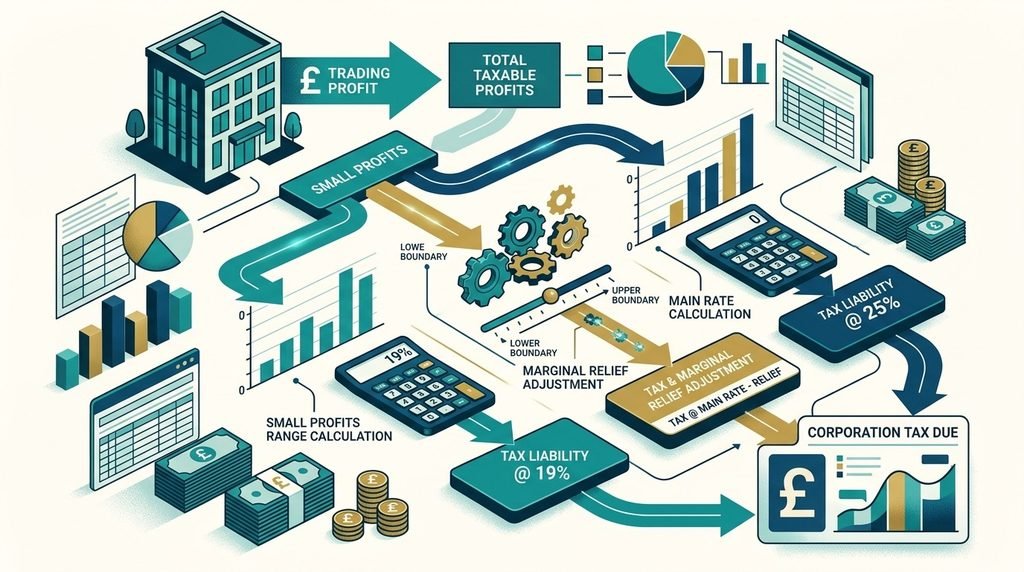
Consider a hypothetical company with taxable total profits of £90,000.
Assumptions
For illustration, assume:
- a 12-month accounting period;
- no associated companies;
- augmented profits equal taxable total profits;
- no special ring-fence profits;
- no additional reliefs, losses or credits affecting the calculation.
For financial year 2026, the small profits rate is 19%, the main Corporation Tax rate is 25%, and marginal relief applies between the £50,000 and £250,000 limits where the conditions are met.
Calculation
Corporation Tax at the 25% main rate:
£90,000 × 25% = £22,500
For this simplified example, marginal relief is:
(£250,000 − £90,000) × 3/200 = £2,400
Corporation Tax after marginal relief:
£22,500 − £2,400 = £20,100
So the illustrative Corporation Tax liability is £20,100, not £17,100 at 19% and not £22,500 at a flat 25%.
HMRC’s marginal-relief formula is more detailed where augmented profits differ from taxable total profits.
What could change the answer?
Plenty.
Associated companies can reduce the £50,000 and £250,000 limits. For example, where a company has associated companies, the limits are divided by the total number of companies concerned, including the company itself.
Short accounting periods can also reduce the thresholds proportionately. Losses, qualifying expenditure, capital allowances and other reliefs may alter taxable profits.
This is exactly why “my accounts show £90,000 profit, so what percentage do I pay?” is not always enough information to calculate Corporation Tax accurately.
Accounting profit isn’t automatically taxable profit
A second common misunderstanding is assuming the profit shown in the accounts is simply multiplied by a Corporation Tax percentage.
Accounting profit and taxable total profits can differ.
Some accounting expenses may not be deductible for Corporation Tax. Other tax deductions or capital allowances may be available even though their treatment in the accounts looks different.
An accountant should therefore be able to explain the bridge between:
accounts → tax adjustments → taxable total profits → Corporation Tax calculation.
If the only figure you receive is “Corporation Tax due: £X”, ask how it was derived.
You should be able to understand the important adjustments without having to become a tax specialist yourself.
Bloom Financials also has a separate guide to the CT600 and Company Tax Return for directors who want to understand what is actually being submitted to HMRC.
How much does a limited-company accountant in London cost?
There is no statutory accountant’s fee, and London pricing varies considerably.
More importantly, apparently similar packages often contain different work. One may include bookkeeping and payroll; another may charge for them separately. Some include a director’s personal tax return, while others do not. “Unlimited advice” can also mean very different things between firms.
A useful quote should make clear:
| Ask about | Why it matters |
| Annual statutory accounts | Confirm preparation and Companies House filing are included |
| CT600 and tax computation | Confirm Corporation Tax compliance is included |
| Bookkeeping | Establish who reconciles transactions and how often |
| Payroll | Check number of employees/directors covered |
| VAT | Confirm whether registration and returns cost extra |
| Confirmation statement | Some firms include it; others do not |
| Personal Self Assessment | Do not assume a director’s return is included |
| Software | Ask whether Xero, QuickBooks, FreeAgent or another platform is included |
| Advice | Check whether ad-hoc questions or scheduled reviews are included |
| Catch-up work | Historic bookkeeping often attracts a separate fee |
| Switching accountant | Establish whether handover work is included |
| VAT on the accountant’s fee | Check whether quoted figures are inclusive or exclusive |
A fixed monthly price can be helpful for budgeting, but only after the scope has been written down.
Cheap compliance that repeatedly requires paid extras may not stay cheap.
Seven checks before appointing a limited-company accountant

1. Check the person’s qualifications and regulation
This deserves more attention than it normally gets.
In the UK, anyone can legally describe themselves as an accountant. ICAEW points out that the word itself does not require a person to have accounting qualifications, training or experience. Protected professional designations are a different matter.
Ask about qualifications, professional-body membership, practising status where applicable, professional indemnity arrangements and experience with companies similar to yours.
2. Ask who will actually handle your company
A good sales call means little if your day-to-day contact changes constantly.
Find out whether you have a named accountant, who answers routine questions and how technical matters are escalated.
3. Ask how early tax liabilities are estimated
If your accountant calculates Corporation Tax only after year-end, you may receive technically correct compliance without much forward planning.
For a cash-sensitive company, knowing the approximate liability during the year can be considerably more useful.
4. Check their bookkeeping process
Year-end accounts cannot fix every problem created by poor records.
Personal spending put through the company, unreconciled bank feeds, duplicated transactions, missing purchase invoices and incorrectly coded director withdrawals all create work later.
Regular bookkeeping support can make year-end work cleaner and management information more reliable.
5. Ask what happens as your company grows
Today’s one-director consultancy could become tomorrow’s VAT-registered employer.
The current compulsory VAT-registration threshold is more than £90,000 of taxable turnover, measured using a rolling 12-month test, with a separate forward-looking test where you expect to exceed the threshold in the next 30 days.
If you’re approaching the threshold, VAT should be discussed before the problem becomes retrospective. Bloom Financials provides VAT support covering areas including registration and compliance.
6. Check Companies House support
Companies House compliance is changing.
Identity verification for directors and people with significant control became a legal requirement from 18 November 2025, with transitional requirements applying to existing directors and PSCs. A company’s confirmation statement can require directors’ personal codes as part of that process.
If you expect an accountant or agent to verify identities for Companies House, ask whether they are registered as an Authorised Corporate Service Provider (ACSP) and what service is actually being provided. Companies House says ACSPs must be supervised for UK anti-money-laundering purposes.
Bloom Financials also provides Companies House compliance support.
7. Ask how the firm handles software filing
A major workflow changed this year.
The old joint service for filing company accounts and Company Tax Returns closed on 31 March 2026. From 1 April 2026, commercial software is required for filing Company Tax Returns with HMRC, apart from limited paper-filing exceptions.
Companies House filing has its own timetable. From 1 April 2028, all companies are due to file annual accounts with Companies House using commercial software in iXBRL format; web and paper accounts filing will then close.
An accountant appointed now should have a credible digital workflow, not a process designed around filing systems that are disappearing.
Common mistakes that create avoidable accounting problems
Treating the company bank account as personal money
A limited company is legally separate from its owners. GOV.UK says there must be a clear division between the company’s finances and those of its owners and directors.
Money taken out needs to be properly identified — for example as salary, a reimbursed expense, dividend or director’s loan.
An unexplained transfer is not automatically a dividend.
Declaring dividends without checking available profits
A company cannot simply distribute whatever cash is sitting in its bank account.
GOV.UK states that dividends must not exceed available profits from current and previous financial years, and companies must keep the required dividend records.
This is a good example of why cash, accounting profit and money available for distribution are not interchangeable concepts.
Checking the VAT threshold once a year
The £90,000 compulsory registration test uses taxable turnover over the previous 12 months, not simply the turnover shown in your latest set of annual accounts.
Fast-growing businesses therefore need to monitor it during the year.
Ignoring associated companies
A director with interests in more than one company can discover that Corporation Tax thresholds do not work as expected.
Association rules are technical, but their practical effect can be substantial because they can reduce the small-profits and marginal-relief limits.
Tell your accountant about other companies under common control rather than assuming they are irrelevant.
Leaving the accountant until the deadline
Late Companies House accounts currently trigger automatic penalties for a private company starting at £150, rising to £1,500 when accounts are more than six months late. Penalties are doubled where accounts are late in two successive financial years.
Late Company Tax Returns have a separate HMRC penalty regime.
The cheapest deadline problem is the one avoided several months earlier.
What records should you give your accountant?
The exact list depends on the business, but a limited-company accountant may require:
- accounting-software access;
- business bank and credit-card statements;
- sales invoices;
- supplier bills and receipts;
- loan and finance documents;
- asset purchases and disposals;
- payroll information;
- VAT records;
- details of expenses paid personally by directors;
- director withdrawals and money introduced;
- dividend records;
- stock records where relevant;
- details of other companies or connected businesses;
- correspondence from HMRC or Companies House.
HMRC says companies must keep records sufficient to prepare annual accounts and Company Tax Returns, including records of money spent and received, assets, liabilities and supporting financial documents.
The cleaner these records are during the year, the less time year-end accounting has to spend reconstructing what happened.
Can you do your limited-company accounting yourself?

Yes — in some circumstances.
A director with a dormant or very simple company, clean records, sufficient knowledge and suitable filing software may choose to handle much of the work.
But DIY becomes less attractive as judgement starts to matter.
| DIY may be manageable where… | Professional support becomes more useful where… |
| Transactions are few and straightforward | Transaction volume is increasing |
| No VAT or payroll is involved | VAT or payroll obligations apply |
| Ownership is simple | There are multiple shareholders or companies |
| Director withdrawals are straightforward | Director’s loan accounts need monitoring |
| You understand the tax computation | Accounts and taxable profits differ materially |
| Cash requirements are predictable | Forecasting and tax provisioning matter |
| Compliance is the only need | You need management reporting or planning |
The key test isn’t whether accounting software can generate a report.
It is whether you understand the accounting and tax consequences of what has been entered into that software.
Does your accountant actually need to be in London?
Not necessarily.
Corporation Tax and Companies House rules do not change because your registered office happens to be in Camden, Canary Wharf or Croydon.
Modern bookkeeping, accounts preparation, payroll and tax filings can usually be handled digitally.
A London-based accountant becomes more relevant where you value face-to-face meetings, have locally specific commercial relationships, want easier physical access to your adviser or simply prefer working with somebody close to the business.
For many companies, however, sector experience, technical competence, response times and service scope matter more than postcode.
That is worth remembering when comparing “London accountant” quotes. Paying more purely for geography makes little sense if another firm offers the expertise and communication model your company actually needs.
When professional accounting support starts paying for itself
The strongest case for an accountant is rarely “forms are difficult”.
It is usually one of these situations:
- you no longer know what the Corporation Tax figure is likely to be;
- bookkeeping is several months behind;
- VAT turnover is moving towards the registration threshold;
- directors are taking money from the business in several different ways;
- the company has employees;
- a second company or new shareholder complicates the structure;
- Companies House or HMRC deadlines are approaching;
- you need figures for lending, investment or a major commercial decision;
- annual accounts are arriving too late to be useful for running the company;
- growth has made cash-flow forecasting more important.
At that stage, professional accounting becomes partly a compliance service and partly an information service.
The latter is often more valuable.
How Bloom Financials can help
Bloom Financials supports businesses with annual accounts and Corporation Tax, bookkeeping, VAT, payroll, management reporting, budgeting and forecasting, cloud accountancy and related compliance work.
If your company needs more than a once-a-year filing service, Bloom can discuss which parts of the accounting process need ongoing support and which you can sensibly retain in-house.
For a business with incomplete bookkeeping, an approaching accounts deadline, uncertainty over Corporation Tax or increasing reporting requirements, speaking to Bloom Financials about an accountant for limited company service is a sensible next step.
You can also contact Bloom Financials to discuss the company’s current records, deadlines and required accounting support before agreeing the scope.
FAQs
Do I legally need an accountant for a limited company?
Usually, no. UK law does not generally require an ordinary private limited company to appoint an accountant simply because it is incorporated.
The director is nevertheless responsible for maintaining records, preparing accounts, dealing with the Company Tax Return and ensuring required filings and tax payments are made. You can delegate the work to an accountant, but not your underlying legal responsibility.
How much should a limited-company accountant cost in London?
There is no official or standard fee. Price depends on transaction volume, bookkeeping quality, payroll, VAT, number of directors, company complexity, software, advisory requirements and whether personal tax work is included.
Compare written scope rather than monthly prices alone. Ask specifically about annual accounts, CT600 preparation, bookkeeping, VAT, payroll, confirmation statements, software and year-round advice.
What is the deadline for limited-company accounts?
For an established private company, annual accounts are normally due at Companies House nine months after the company’s financial year ends.
First accounts are usually due 21 months after incorporation, although first-year rules require particular care because Companies House and Corporation Tax accounting periods can differ.
When does a limited company pay Corporation Tax?
A company that is not subject to the large-company instalment rules normally pays Corporation Tax nine months and one day after its Corporation Tax accounting period ends.
The Company Tax Return itself is normally due later — 12 months after the accounting period ends.
Can I switch accountants before my company year-end?
Yes. You do not normally need to wait until year-end to change accountants.
In practice, make sure responsibilities are explicit during the handover: who is filing the next accounts, who is dealing with VAT or payroll in the meantime, what records have transferred, and what outstanding HMRC or Companies House correspondence needs action.
Does a dormant limited company still need an accountant?
Not necessarily, but being dormant does not remove all company obligations. Companies House guidance states that companies generally still need to file annual accounts even when they are dormant or not trading.
Whether paying an accountant makes sense depends on how confident you are preparing the appropriate dormant accounts and maintaining the company’s other statutory obligations.
Should my accountant handle my personal Self Assessment as well?
Possibly, but don’t assume it is automatically included in a limited-company package.
The company and its director are separate taxpayers. Whether you personally need Self Assessment depends on your circumstances and HMRC’s rules, not simply on the fact that the company has an accountant. Ask whether personal tax work is included and whether your own income sources create a filing requirement.
What should I ask an accountant at the first meeting?
Bring your latest accounts, current bookkeeping position, Companies House year-end, HMRC UTR, VAT and payroll status, details of directors/shareholders, information about connected companies and any recent HMRC correspondence.
Then ask three practical questions: What do you need from me, what exactly will you handle, and when will I know what tax is likely to be due?
Those answers reveal far more than a generic list of services.
Bottom line
Finding an accountant for limited company work in London should not come down to the nearest office or the lowest advertised monthly fee.
Look for a firm that understands how statutory accounts, Corporation Tax, bookkeeping, VAT, payroll and Companies House obligations fit together — and that can explain the numbers before the deadline makes the decision for you.
The accountant can do the calculations and filings. The director still needs enough visibility to know what is happening, what cash must be retained and what decisions require attention.
Figures and rules checked against official UK sources on 1 September 2026. This article provides general information rather than personalised tax or accounting advice. Rules can depend on a company’s accounting period, structure and individual circumstances. A suitably qualified accounting professional should review the final publication for technical accuracy and brand-specific professional judgement.