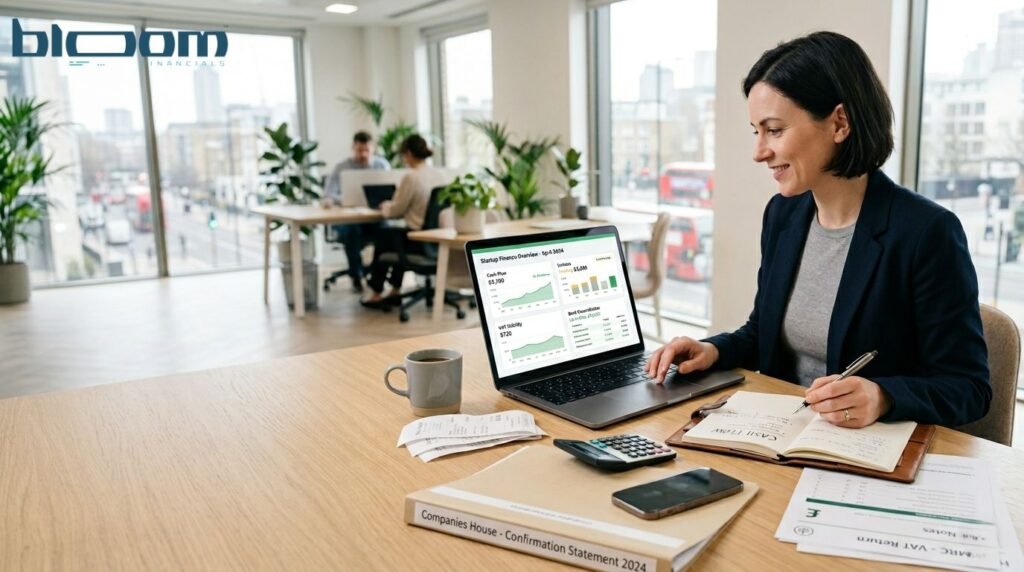
Bookkeeping for startups is not just about “keeping the books tidy”. It is what stops messy records, missed invoices, tax stress, VAT surprises, weak cash flow and poor business decisions from creeping in while you are busy trying to win customers. Many founders only take bookkeeping seriously once something goes wrong: a forgotten £1,200 invoice, a box of unclaimed receipts, or a tax bill that feels bigger than expected.
Good bookkeeping gives you a clear view of what is coming in, what is going out, what you owe HMRC, and whether the business is actually making money.
Table of Contents
ToggleWhat is bookkeeping for startups?
Bookkeeping for startups is the process of recording, organising and checking a new business’s financial transactions from day one. It includes sales invoices, expenses, bank payments, receipts, payroll, VAT records, cash flow and reconciliations. Done properly, it helps founders stay compliant, understand profit, avoid HMRC issues and make better decisions before problems build up.
Bookkeeping for startups means keeping accurate records of every business transaction so your accounts, tax returns and management reports are based on reliable information. It covers the everyday financial detail behind your business: sales, purchases, receipts, payments, bank balances, VAT, payroll and owner withdrawals.
In practical terms, it answers simple but important questions:
- Who owes you money?
- Which bills need paying?
- How much tax should you put aside?
- Are you making profit or just generating turnover?
- Can you afford your next hire, laptop, stock order or software subscription?
Accounting uses those records to prepare accounts, calculate tax and advise you. Bookkeeping creates the foundation.
Why bookkeeping matters from day one
A startup can look busy and still be financially unclear. You might have new clients, a growing Stripe balance, a few Amazon purchases, a £12.99 software subscription, and payments moving through several accounts. Without a system, it becomes hard to separate business performance from bank balance noise.
Good bookkeeping from day one helps you:
- Invoicing faster so cash comes in sooner.
- Track allowable expenses instead of guessing at year’s end.
- Prepare for tax rather than being shocked by it.
- Monitor VAT thresholds before registration becomes urgent.
- Understand cash flow before committing to new costs.
- Give accountants clean records, which usually makes advice more useful.
For limited companies, directors are responsible for keeping the company and accounting records even when they hire someone else to help.
The real cost of poor bookkeeping for a startup
Poor bookkeeping rarely fails all at once. It usually starts small: a few missing receipts, personal spending mixed with business payments, invoices marked as paid when they are not, or software categories left as “miscellaneous”.
The cost can show up in several ways:
- Lost cash: A £1,200 invoice left unpaid for 45 days can affect rent, supplier payments or your own drawings.
- Missed tax relief: A £250 laptop accessories purchase may be allowable if it is genuinely for business use, but you need the record.
- Late filings: Missing deadlines can lead to penalties and interest.
- Bad decisions: A business may appear profitable because unpaid bills, VAT or Corporation Tax have not been allowed for.
- Higher professional fees: Sorting twelve months of messy records takes longer than reviewing clean monthly books.
If another business pays late, statutory interest on late commercial payments is generally 8% plus the Bank of England base rate, unless a contract sets a different rate.
Separate business and personal finances
The first rule is simple: keep business and personal money apart.
For a limited company, the company is a separate legal entity, so mixing personal spending with company payments creates messy director’s loan issues. For sole traders, a separate business bank account may not always be legally required, but it makes record-keeping far easier.
Use one bank account for business income and expenses. Pay yourself clearly. Avoid using the business card for groceries, family travel or personal subscriptions. If something has mixed use, such as a mobile phone or home office cost, record it carefully and ask an accountant how much can reasonably be claimed.
Choosing the right bookkeeping method: spreadsheet, software or accountant
A spreadsheet may work for a very small side business with low transaction volume. But once you have regular invoices, online payments, VAT, stock, payroll or several platforms, bookkeeping software is usually safer and faster.
| Method | Best for | Pros | Watch-outs |
| Spreadsheet | Very early-stage sole traders with few transactions | Low cost, flexible, easy to start | Easy to break formulas, weak audit trail, poor VAT/MTD readiness |
| Bookkeeping software | Growing startups, ecommerce, contractors, freelancers | Bank feeds, invoice tracking, reports, and digital records | Needs a correct setup and regular review |
| Outsourced bookkeeping | Busy founders, VAT-registered businesses, and limited companies | Saves time, better categorisation, cleaner month-end | Cost depends on volume, complexity and support level |
| Accountant-led system | Startups needing tax planning, reporting and compliance | Combines records, advice and deadlines | Requires regular communication and timely documents |
Typical startup bookkeeping costs vary. A simple business might spend around £10–£40 per month on software, perhaps including a £12.99 subscription, while outsourced bookkeeping might range from around £100 to £400+ per month, depending on transactions, VAT, payroll, ecommerce platforms and reporting needs. These are practical planning examples, not fixed prices.
Setting up a chart of accounts
A chart of accounts is the list of categories used to organise your transactions. It normally includes income, cost of sales, expenses, assets, liabilities and equity.
A clean chart of accounts helps you see what the business is really doing. For example, putting all costs into “general expenses” tells you very little. Splitting costs into software, advertising, subcontractors, travel, office costs and professional fees gives better insight.
For startups, keep it practical. Do not create 80 categories if you only need 25. The goal is useful reporting, not complexity.
Recording sales, invoices and payments
Record sales when you raise invoices or receive income, depending on the accounting basis used for your business. Keep the invoice number, date, customer name, amount, VAT if applicable, due date and payment status.
For payment terms, many startups use 7, 14 or 30 days. Shorter terms can help cash flow, but they must be clear on the invoice and agreed with the customer. A 30-day invoice for £1,200 is not the same as £1,200 in the bank. Until it is paid, you still need cash for subscriptions, wages, tax savings and supplier bills.
Good bookkeeping should show:
- invoices issued;
- payments received;
- overdue invoices;
- credit notes;
- sales platform income;
- payment processor fees.
Tracking expenses and allowable business costs
Allowable expenses are business costs that can usually be deducted when calculating taxable profit, provided they are wholly and exclusively for business purposes. Some costs have special rules, so do not assume everything paid from the business account is automatically allowable.
| Expense | Example | How to record it | Common mistake |
| Software | £12.99 accounting app subscription | Software or subscriptions | Posting it as general expenses every month |
| Equipment accessories | £250 monitor, keyboard and laptop stand | Computer equipment or office equipment | Losing the receipt or mixing personal use |
| Travel | Train to client meeting | Travel | Claiming normal commuting as business travel |
| Advertising | £300 LinkedIn campaign | Marketing and advertising | Not separating VAT or platform fees |
| Professional fees | Accountant, solicitor, consultant | Professional fees | Posting advice fees into random categories |
| Stock | £2,000 product order | Purchases or inventory | Treating stock and office costs the same |
| Home office | Business proportion of home costs | Use of home or home office | Guessing without a reasonable method |
If you are unsure whether a cost is allowable, keep the receipt and ask a qualified accountant. Tax rules can change, and the correct treatment depends on your business structure and facts.
Keeping receipts and digital records
Keep evidence for income and expenses. A bank payment alone does not always explain what was bought, why it was bought, or whether VAT was charged.
Sole traders must keep records of business income and expenses for Self Assessment, and HMRC says records should be kept for at least five years after the 31 January submission deadline for the relevant tax year.
Limited companies generally need to keep company records for six years from the end of the last company financial year they relate to, or longer in certain situations.
Use receipt capture tools, attach files to transactions and avoid relying on email searches months later.
Bank reconciliation explained simply
Bank reconciliation means checking that the transactions in your bookkeeping system match your actual bank statement.
It is one of the most important bookkeeping habits. If the bank says you have £8,400 but your software says £9,100, something is wrong. It could be a duplicated transaction, an invoice marked paid twice, a missing bank charge, or a payment posted to the wrong account.
Do this monthly at a minimum. High-volume ecommerce sellers may need it weekly.
Understanding cash flow, profit and tax
Profit is not the same as cash. Tax is not the same as profit. Turnover is not the same as money available to spend.
A startup might make £10,000 in sales, have £3,000 in expenses, and show a £7,000 profit. But if £4,000 of invoices are unpaid, cash is much lower. If VAT applies, part of the money collected may belong to HMRC. If you are a sole trader, Income Tax and National Insurance may be due later. If you run a limited company, Corporation Tax is payable based on taxable profits.
Good bookkeeping helps you set aside tax as you go, rather than treating every bank balance as spare cash.
VAT basics for startups
VAT is based on taxable turnover, not profit. You must register for VAT if your total taxable turnover for the last 12 months goes over £90,000, and you must register within 30 days of the end of the month when you went over the threshold.
For example, if your startup has £90,000 of taxable sales but only £12,000 of profit, the VAT threshold still matters because it is based on taxable turnover. You should also register if you expect taxable turnover to go over the threshold in the next 30 days alone.
VAT-registered businesses normally submit VAT Returns and pay VAT one calendar month and seven days after the end of the VAT accounting period.
Startups should review VAT early if they sell digital products, ecommerce goods, cross-border services, construction services, or mixed taxable and exempt supplies.
Making Tax Digital and why digital records matter
Making Tax Digital, or MTD, is HMRC’s move towards digital record-keeping and software-based tax submissions.
All VAT-registered businesses should now keep VAT records and submit VAT Returns using compatible software unless exempt.
For Income Tax, MTD starts in phases. Sole traders and landlords with qualifying income over £50,000 for the 2024 to 2025 tax year need to use it from 6 April 2026; those over £30,000 for 2025 to 2026 from 6 April 2027; and those over £20,000 for 2026 to 2027 from 6 April 2028.
So, a sole trader with £50,000+ qualifying income should not wait until the deadline to organise digital records. Setting up software now reduces stress later.
Payroll, directors’ pay and dividends where relevant
If your startup has employees, payroll records must be accurate. Employers running payroll need to report employees’ payments and deductions to HMRC on or before each payday.
For limited company directors, pay often involves salary, dividends, expenses and sometimes directors’ loans. These are not interchangeable. A dividend needs company profit and proper documentation. A director’s loan needs careful tracking. Directors receiving dividends may need to complete a Self Assessment in some circumstances.
This is an area where startup founders should take tailored advice before copying what another founder does.
Bookkeeping for sole traders vs limited companies
| Area | Sole trader | Limited company |
| Legal position | You and the business are the same legal person | The company is separate from the director |
| Tax reporting | Self Assessment tax return | Company accounts, Corporation Tax return, and possibly director Self Assessment |
| Owner pay | Drawings are not wages | Salary, dividends, expenses or director’s loan |
| Record keeping | Income and expenses records | Company accounting records, statutory records and director transactions |
| Tax deadlines | Online Self Assessment and tax payment usually due 31 January; second payment on account may be due 31 July | Corporation Tax usually due 9 months and 1 day after period end; Company Tax Return due 12 months after period end |
| Companies House | Not applicable | Annual accounts usually due 9 months after financial year end; first accounts have a different deadline |
Self Assessment paper returns are usually due by 31 October and online returns by 31 January, with tax also due by 31 January. Payments on account, where relevant, are due on 31 January and 31 July.
For private limited companies, annual accounts are normally due at Companies House nine months after the company’s financial year end, Corporation Tax payment is due nine months and one day after the accounting period, and the Company Tax Return is due 12 months after the accounting period ends.
Weekly, monthly and quarterly bookkeeping tasks
A simple routine prevents most bookkeeping problems.
| Frequency | Task | Why it matters |
| Weekly | Raise invoices and check overdue customers | Protects cash flow |
| Weekly | Upload receipts and supplier bills | Avoids lost records |
| Weekly | Review bank feed transactions | Spots errors early |
| Monthly | Complete bank reconciliation | Confirms books match the bank |
| Monthly | Review profit and loss | Shows whether the business is making money |
| Monthly | Check unpaid invoices and bills | Helps planning and credit control |
| Monthly | Set aside money for tax and VAT | Reduces deadline stress |
| Quarterly | Review VAT position or submit VAT Return if registered | Avoids VAT surprises |
| Quarterly | Review cash flow forecast | Supports hiring, stock and spending decisions |
| Quarterly | Speak to accountant about tax planning | Helps decisions before year end |
Common bookkeeping mistakes startups make
The most common mistake is leaving bookkeeping until the tax deadline. By then, the useful decision-making value has already been lost.
Other common issues include:
- Mixing personal and business transactions.
- Not chasing unpaid invoices.
- Recording income from Stripe, Shopify, Amazon or PayPal without deducting fees properly.
- Claiming costs without receipts.
- Ignoring VAT until turnover is close to £90,000.
- Treating profit as spendable cash.
- Not reconciling the bank.
- Paying directors without recording salary, dividends or loan movements correctly.
- Using too many expense categories.
- Not reviewing reports until year end.
When to hire a bookkeeper or accountant
You should consider help when bookkeeping is taking time away from customers, sales or delivery, or when the business has become too complex for a spreadsheet.
It is especially sensible to get support if you:
- are approaching the VAT threshold;
- run a limited company;
- have payroll or directors’ dividends;
- sell through ecommerce platforms;
- use multiple payment processors;
- need cash flow reports;
- are applying for funding;
- have fallen behind with records;
- want tax planning before year-end.
A bookkeeper can keep records accurate and up to date. An accountant can use those records for accounts, tax, compliance and advice. Many startups need both working together.
How Bloom Financials helps startups with bookkeeping
Bloom Financials works with UK startups, SMEs, sole traders and limited companies that want clearer records and less tax-time panic.
Support can include bookkeeping setup, transaction categorisation, bank reconciliation, VAT support, Making Tax Digital support, accounting software guidance, cash flow reporting, management accounts, tax planning and statutory compliance.
For founders who want a practical starting point, Bloom Financials can review how your records are currently kept, identify gaps, clean up categories and help set up a routine that fits your business. You can also explore Bloom Financials’ Bookkeeping support if you want your records managed more consistently.
This is not about making the books look tidy for their own sake. It is about giving you numbers you can trust when you are deciding whether to hire, buy stock, register for VAT, take dividends or invest in growth.
Final checklist for getting bookkeeping right from day one
Use this checklist as your startup bookkeeping baseline:
- Open a separate business bank account.
- Choose bookkeeping software or a clear spreadsheet system.
- Set up a sensible chart of accounts.
- Record sales invoices as soon as they are issued.
- Add payment terms to invoices.
- Chase overdue invoices weekly.
- Upload receipts and supplier bills.
- Categorise expenses consistently.
- Reconcile bank accounts monthly.
- Track VAT taxable turnover.
- Keep digital records for HMRC.
- Review profit and loss each month.
- Maintain a cash flow forecast.
- Record payroll, dividends and directors’ loans properly.
- Note tax and filing deadlines.
- Speak to a qualified accountant before making major tax decisions.
FAQs
Do startups need bookkeeping from day one?
Yes. Startups should keep bookkeeping records from the first transaction. Early records make tax, cash flow, VAT monitoring and funding conversations much easier.
Can I do bookkeeping myself as a startup?
Yes, many founders start by doing their own bookkeeping. Use reliable software or a well-structured spreadsheet, keep receipts, reconcile monthly and ask an accountant to check the setup.
What records should a UK startup keep?
Keep sales invoices, purchase invoices, receipts, bank statements, payroll records, VAT records, loan agreements, director payments and supporting documents for business expenses.
How often should a startup update its books?
Weekly is best for invoices, receipts and bank transactions. At minimum, complete a monthly bank reconciliation and review profit, cash flow and unpaid invoices.
What bookkeeping mistakes cause HMRC problems?
Missing income, unsupported expense claims, poor VAT records, mixed personal spending, late payroll reporting and weak director’s loan records can all cause problems if HMRC asks questions.
When should a startup register for VAT?
A startup must register when taxable turnover for the previous 12 months goes over £90,000, or if it expects taxable turnover to go over the threshold in the next 30 days alone. The threshold is based on taxable turnover, not profit.
Does Making Tax Digital affect startups?
Yes, it can. VAT-registered startups generally need MTD-compatible software for VAT. Sole traders and landlords may also come into MTD for Income Tax depending on qualifying income and start date.
Is bookkeeping different for sole traders and limited companies?
Yes. Sole traders report through Self Assessment. Limited companies need company accounts, Corporation Tax records, Companies House filings and careful records of salary, dividends and directors’ loans.
How can Bloom Financials help with startup bookkeeping?
Bloom Financials can help with bookkeeping setup, transaction categorisation, bank reconciliation, VAT support, MTD software, management accounts, cash flow reporting, tax planning and statutory compliance.
Conclusion: Bookkeeping for startups
Bookkeeping for startups is easiest when it begins before the records become messy. A simple system, used regularly, can help you understand cash flow, avoid missed invoices, prepare for VAT and MTD, and give your accountant the information needed to advise properly.
The main point is not perfection. It is consistency. Keep business and personal money separate, record transactions promptly, reconcile the bank, keep receipts and review your numbers before decisions become urgent.
If you want help setting up or improving your startup bookkeeping, Bloom Financials can support you with clean records, software guidance, VAT readiness, cash flow reporting and practical UK accounting advice. Book a consultation with Bloom Financials to get your bookkeeping right from day one.