
An unexpected HMRC tax calculation arrives. Your employer already deducts Income Tax, and your bank has simply paid savings interest. Why is HMRC asking for money?
If you’ve received an HMRC Savings Tax letter, it usually means HMRC has used information about your savings interest to review your Income Tax position. You might owe tax, be due a refund or simply need to check an estimate in your PAYE tax code. The letter itself does not prove that you owe the amount shown. First identify the type of notice and tax year, then compare its interest figure with your records and allowances.
Here’s how to check the figures and decide what to do.
What does an HMRC Savings Tax letter actually mean?
“HMRC Savings Tax letter” isn’t the formal name of a single document. People use the phrase for correspondence about tax on bank or building society interest. The document may be a P800 calculation, a Simple Assessment (PA302) or a notice that HMRC has adjusted their PAYE tax code.
A P800 may show a tax underpayment or overpayment. A PA302 is a formal bill; a tax-code notice may contain an estimate for an unfinished year. They aren’t all immediate payment demands.
Read the heading, reference, tax year and deadline. The largest pound figure may represent interest or a coding adjustment rather than tax due.
Why is HMRC sending savings-interest letters in 2026?
The timing isn’t unusual. Banks and building societies report interest paid to customers after each tax year ends on 5 April. HMRC combines that information with PAYE, pension and other tax records. It can then compare your total Income Tax liability with tax already collected.
In a July 2026 announcement, HMRC confirmed that a further batch of Simple Assessment letters involving bank and building society interest would be issued between October and December 2026. These relate to 2025/26, the tax year running from 6 April 2025 to 5 April 2026.
This is why a letter may arrive months after you received the interest. Since April 2016, ordinary UK bank savings interest has generally been paid without Income Tax deducted at source. Receiving the money gross doesn’t automatically make it exempt; the tax position depends on your income and available allowances.
For example, someone may have earned £900 from one account and £750 from another. HMRC considers their combined £1,650 alongside the person’s other income and allowances.
Which HMRC document have you received?
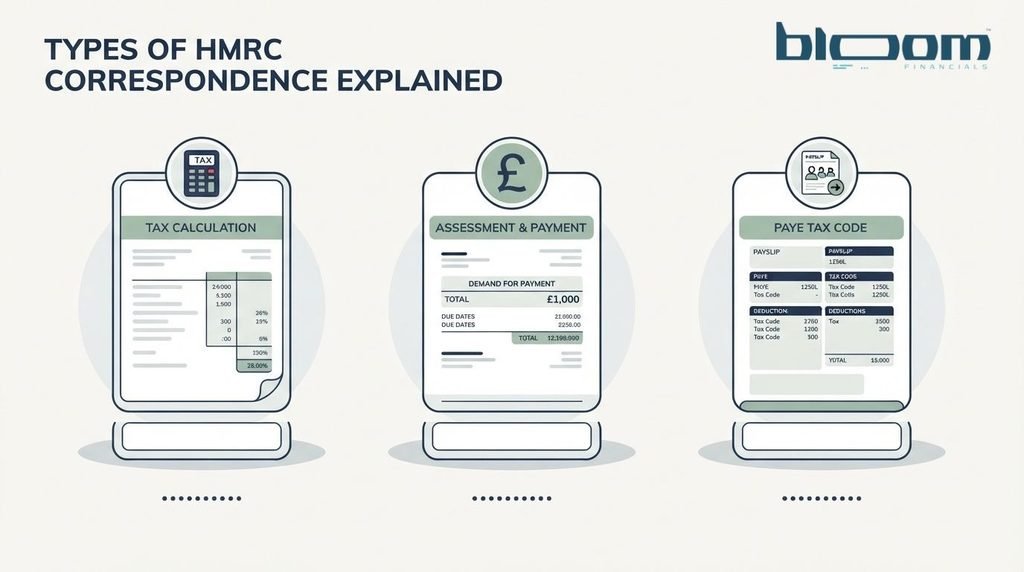
| Document | What it normally tells you | What to check first |
| P800 tax calculation | Whether you paid too much or too little Income Tax for a completed year | The calculation, tax already deducted and whether HMRC plans to change your code |
| Simple Assessment (PA302) | Tax HMRC says you owe that it cannot collect automatically, together with payment instructions | The tax year, amount due, 60-day query period and payment deadline |
| PAYE tax-code notice (often P2) | How HMRC intends to calculate deductions from wages or a pension | Whether savings interest is an estimate or a prior-year underpayment |
| Self Assessment notice | A requirement to file a tax return | The tax year, filing obligation and deadline, even if you also received another letter |
The Bloom Financials guide to P800 calculations explores that document in more detail. For a PA302, use the official Simple Assessment guidance rather than assuming it works like a tax return.
A new PA302 for the same tax year may replace an earlier one. It generally shows the revised total liability, not a wholly additional charge. Suppose you paid a £180 Simple Assessment and later received a revised calculation showing £260 for the same year. Assuming there are no other adjustments, the balance is £80, not another £260. Check HMRC’s recorded payments before paying again.
Do you have to pay tax on your savings interest?
Not necessarily. Tax applies to relevant interest earned, not the amount sitting in your accounts. A £40,000 savings balance is not itself a £40,000 taxable receipt. Whether its interest creates a liability depends on your other income, tax band and allowances.
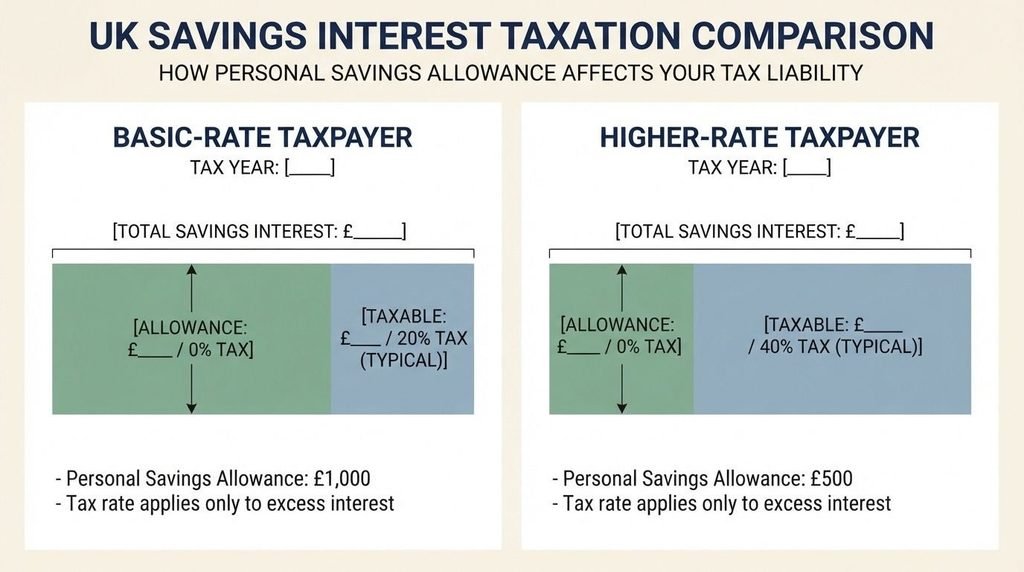
For both 2025/26 and 2026/27, the standard Personal Allowance is £12,570, subject to individual circumstances and reductions for higher incomes. If wages or pensions haven’t used it all, the remainder may cover savings interest. Low-income savers may also qualify for the starting rate for savings, and most basic- or higher-rate taxpayers have a Personal Savings Allowance (PSA).
| Tax position | Personal Savings Allowance | General savings-tax rate in 2025/26 and 2026/27 |
| Basic-rate taxpayer | £1,000 | 20% |
| Higher-rate taxpayer | £500 | 40% |
| Additional-rate taxpayer | £0 | 45% |
The PSA is a 0% tax band, not a deduction that removes interest from total income. Your total income can affect the band that applies; boundaries, the Personal Allowance taper above £100,000 and reliefs complicate some cases. Scotland has different rates on earnings and pensions, but savings rates are UK-wide.
For the latest rules, see HMRC’s guide to tax-free savings interest. Bloom Financials also has a broader guide to savings tax if you’d like more background on the allowances.
Four worked examples: what the figures actually mean
The following scenarios are illustrative, not individual tax advice. They assume the income stated is the person’s relevant income, the savings interest is taxable UK interest outside an ISA, there are no special reliefs, and all interest falls within the tax band used. Figures use 2025/26 or 2026/27 rates, not the proposed future rates.
Example 1: A basic-rate employee with £1,600 interest. An employee earning £32,000 has savings interest of £1,600. Their £1,000 PSA is taxed at 0%, leaving £600 × 20% = £120 of savings tax. That is potentially the extra liability before allowing for any tax already collected through PAYE. It isn’t a tax charge on the savings balance.
Example 2: A higher-rate employee with £1,200 interest. Someone earning £65,000 has £1,200 interest. Their PSA is £500, leaving £700 × 40% = £280 of savings tax. Their income remains within the higher-rate band under these assumptions. The same £1,200 could produce a different result for somebody whose income places them in another band.
Example 3: A pensioner entitled to the starting rate. A pensioner receives £14,000 in pension income and £4,200 in savings interest. The pension uses their £12,570 Personal Allowance and exceeds it by £1,430. Their maximum £5,000 starting-rate band for savings is therefore reduced by £1,430, leaving £3,570 taxed at 0%. The remaining £630 of interest is covered by their £1,000 PSA. Savings tax due: £0. If the interest were £4,800 instead, £230 would fall outside those two nil-rate bands, potentially giving £230 × 20% = £46 of tax. This illustrates why being a pensioner doesn’t automatically mean paying tax on bank interest, or automatically mean being exempt.
Example 4: A couple with a joint account. A jointly held account pays £2,400 interest and, on the assumed equal split, £1,200 belongs to each partner for tax purposes. One partner is a basic-rate taxpayer with no other savings interest: (£1,200 − £1,000) × 20% = £40. The other is a higher-rate taxpayer, also with no other savings interest: (£1,200 − £500) × 40% = £280. Their combined potential savings tax is £320, although they share the same account.
Interest exceeding £1,000 does not automatically mean tax is due. Check the complete year’s income.
How does HMRC know how much bank interest you earned?
Banks and building societies normally report relevant interest to HMRC after the tax year. HMRC may receive information from several institutions, including accounts you rarely use or have since closed. It can then combine the interest with your PAYE and pension records.
For 2025/26 calculations, the Low Incomes Tax Reform Group reported on 19 November 2026 that HMRC intended to provide account-by-account interest information where an affected taxpayer has six or fewer accounts. With seven or more, an aggregate figure may be shown instead. This presentation can help, but it doesn’t guarantee every figure is accurate; ask HMRC for a breakdown if you cannot match the total.
HMRC may also use historical interest to estimate a current year’s taxable savings income. That is a forecast for tax coding, not confirmation that the same interest was earned again.
How to check your HMRC savings tax calculation against your bank statements
The most useful check is a reconciliation: rebuild the interest figure yourself before arguing about the tax rate.
Step 1 — Identify the period. If the letter says 2025/26, examine interest arising from 6 April 2025 to 5 April 2026. Don’t use a January-to-December bank summary without adjusting for the tax-year dates. For fixed-term products, when interest becomes taxable can depend on when it is credited and available under the account terms.
Step 2 — Gather every account. Obtain annual interest certificates or statements for current, closed and little-used accounts. Include taxable savings interest from relevant institutions, not merely your main current account. Keep ISA statements separate, because genuine ISA interest is exempt.
Step 3 — Record your share. A joint account’s full interest shouldn’t automatically be counted against each holder. Normally HMRC divides joint interest equally; if beneficial ownership differs, the correct treatment depends on the actual rights and circumstances, not just what split would minimise tax.
Step 4 — Compare with HMRC. Here’s a fictional example of a saver reconciling the 2025/26 figure:
| Account | Interest shown on statement | Amount attributable to saver |
| Easy-access account | £520.45 | £520.45 |
| Fixed-term account | £810.20 | £810.20 |
| Joint account | £840.00 | £420.00 |
| Cash ISA | £310.00 | £0.00 taxable |
| Total taxable interest | £1,750.65 |
If HMRC’s taxable-interest figure were £2,170.65, the £420 difference would be consistent with the whole £840 joint-account interest being included rather than the saver’s £420 share. That’s a reason to investigate, not proof of where the error occurred. Check each bank’s reported figures and obtain supporting statements.
Step 5 — Check the tax, not just the interest. Look at your other income, unused Personal Allowance, applicable starting-rate band, PSA, previous PAYE deductions and any earlier payment. Separate the amount of interest from the amount actually liable to tax. Then check whether a current PAYE code includes an estimate for a different tax year.
Keep a worksheet showing each account, tax year, interest, ownership share and evidence to support any HMRC enquiry.
Is the HMRC savings tax letter genuine?
A genuine HMRC letter can arrive unexpectedly. Equally, an unexpected letter isn’t automatically genuine simply because it uses an official-looking heading. Verify it independently before sharing information or paying.
Check the reference and tax year, compare the notice with records available in your Personal Tax Account, and use contact details you obtain independently from GOV.UK. HMRC publishes guidance for checking genuine letters. Not finding an exact example in its list does not by itself establish that a letter is fraudulent.
Be especially cautious if a text, email or QR code accompanying the correspondence tells you to pay immediately via an unfamiliar website. Don’t enter banking or sign-in details through an unverified link. Type gov.uk into your browser yourself and navigate to the relevant tax service. If unsure, contact HMRC using an independently verified official number.
What if the interest or tax amount in your letter is wrong?
Contact HMRC and explain the specific discrepancy, supported by your records. A general objection that you have ‘already paid tax’ may not establish whether PAYE actually covered the savings interest.
Tell HMRC the tax year, the bank or building society involved, the figure used, the figure you believe is correct and how you calculated it. Have interest certificates, bank statements, payslips, P60s and pension records available as relevant. Where the bank’s reporting appears incorrect, HMRC may ask for the institution to check or correct its data.
For a Simple Assessment (PA302), contact HMRC within 60 days of the date on the notice if you disagree with its calculation. HMRC may issue a revised assessment. If it rejects your query, its decision letter explains how to appeal; the official guidance gives a further 30-day appeal period from the decision letter. Importantly, challenging a PA302 does not automatically postpone payment. The original deadline remains unless HMRC tells you it has been extended. See HMRC’s dispute guidance.
For a P800, contact HMRC if the income, tax deductions or allowances look wrong. If HMRC agrees, it can issue a corrected calculation. If your PAYE code contains an implausible savings-interest estimate, ask for that estimate to be reviewed as well. You can find broader tax-code explanations in Bloom Financials’ HMRC tax guide.
When do you have to pay an HMRC savings tax bill?
The answer depends on the type and date of the notice, not merely the date you received interest.
For a 2025/26 Simple Assessment dated before 31 October 2026, the payment deadline is 31 January 2027. For one dated 31 October 2026 or later, HMRC says the tax is due within three months of the letter’s date. Read your actual notice because it specifies the deadline that applies.
You can normally pay a PA302 through the official HMRC online service, by bank transfer or by cheque, using its 14-character reference starting with X. Check payment details on GOV.UK’s Simple Assessment payment page. Small payments are possible, but the whole amount generally must be paid by the deadline. If paying is difficult, contact HMRC promptly about available support rather than ignoring the bill.
A P800 is different. HMRC will often collect an eligible underpayment of less than £3,000 through a later PAYE tax code, provided there is sufficient PAYE income to do so. The letter should explain whether any direct payment is needed. Someone already submitting Self Assessment must deal with taxable savings income through the appropriate return rather than assuming a PA302 replaces their filing obligation.
Can HMRC collect savings tax through your PAYE code?
Yes. HMRC can alter the code used by your employer or pension payer to collect an earlier underpayment or account for estimated interest in the current year. This can reduce take-home pay even though your salary hasn’t changed.
Consider the employee in Example 1, whose 2025/26 savings interest produces a £120 liability. If it hasn’t already been collected and HMRC can use PAYE, that £120 might be collected in 2027/28. At a straightforward 20% rate, a £600 reduction in coding allowances could collect £120 over the year. The £600 is a coding adjustment, not £600 of tax owed. The actual code calculation may differ if other factors apply.
Separately, HMRC could put an estimated amount of 2026/27 interest into the 2026/27 code using the previous year’s figures. That adjustment concerns expected current-year interest, not another collection of the 2025/26 interest itself. When the actual figures arrive after 5 April 2027, HMRC can reconcile the result.
If you’ve closed a savings account or rates have fallen sharply, check whether the estimate is now too high. The Personal Tax Account lets you inspect your Income Tax estimate and code. An inaccurate forecast is worth correcting, even where the final reconciliation would eventually sort things out.
Special circumstances: pensioners, joint accounts and ISAs
Pensioners. State Pension is taxable income but is generally paid without tax deducted first. Private pensions may be taxed through PAYE. HMRC therefore needs to consider pension income alongside interest and other income. The starting rate for savings can shelter substantial interest where non-savings income is low enough, as Example 3 shows. A PA302 could also relate partly to untaxed State Pension, not solely bank interest. Check each line before assuming the entire demand is a savings-tax charge.
Joint accounts. HMRC ordinarily splits interest equally for joint account holders. For married couples or civil partners, changing the 50:50 tax treatment requires the actual beneficial entitlement and, where applicable, the proper declaration and evidence. Form 17 isn’t a general election to shift interest to whichever partner pays less tax. Bloom Financials’ joint-savings article provides a background introduction; unusual ownership arrangements merit individual checking.
ISAs and other products. Interest within a genuine Cash ISA is tax-free and shouldn’t appear in the taxable savings-interest total. Some National Savings and Investments products are also tax-free, while other products generate taxable interest. Foreign savings income and certain children’s accounts have additional rules. Don’t simply subtract every item labelled ‘savings’ without identifying its tax treatment.
Self Assessment. If you already file a return, include relevant taxable savings income for the correct tax year. GOV.UK also says people whose savings interest is more than £10,000 must report it through Self Assessment. That is a reporting trigger, not a £10,000 tax-free allowance. If you’ve received both a tax return notice and a Simple Assessment for the same year, contact HMRC to establish how the assessment should be handled; don’t ignore the return notice.
What’s changing for savings tax from April 2027?
The rates used in a letter for 2025/26 must be the rules applicable to that year. Likewise, the standard savings rates for 2026/27 remain 20%, 40% and 45%. The October Budget 2026 proposed rates for 2027/28 of 24%, 44% and 49% from 6 April 2027, subject to Finance Bill 2026–27 legislation.
These future rates should not be applied retrospectively to interest earned in 2025/26. The Personal Savings Allowance remains shown as £1,000 for basic-rate and £500 for higher-rate taxpayers in the government’s current published 2027/28 tables. Review the final legislation before relying on these figures for future planning.
For wider decisions about ISAs, pensions and allowances, see Bloom Financials’ 2026/27 tax-planning guide. Tax planning should fit your circumstances, not be driven only by a surprising letter.
How can you avoid another unexpected letter?
Keep an annual record of gross savings interest, including joint-account shares and any closed accounts. Update it after 5 April each year rather than waiting for HMRC. Review tax-code notices for estimated interest, particularly following a large one-off deposit or a change in interest rates. Make sure you know which products are exempt and which are taxable.
There’s also value in keeping previous letters and payment confirmations. If HMRC revises a calculation, you’ll have evidence of what was already assessed and paid. These records make future errors easier to resolve.
Frequently asked questions
Why have I received an HMRC letter when my bank already paid my interest?
Your bank normally pays interest without deducting Income Tax. HMRC receives information about that interest and may calculate tax later, taking account of your income and allowances. The fact that interest reached your account doesn’t establish that it was tax-free.
Does everyone receiving an HMRC savings-interest letter owe money?
No. A P800 might show a refund, and a tax-code notice may be based on an estimate. Even if the interest total is correct, unused Personal Allowance, the starting rate or the PSA may mean there is little or no savings tax to pay.
Can I ignore a letter if the amount seems wrong?
No. Check it and contact HMRC promptly. A PA302 has a 60-day period for querying the calculation, and a dispute doesn’t automatically suspend its payment deadline. Record the date, evidence and outcome of your contact.
What if I receive two Simple Assessment letters for the same year?
The later assessment generally shows the updated total liability. Check what you’ve already paid against that total. Don’t assume the whole revised figure is a new charge on top of an earlier payment.
Will an ISA prevent an HMRC savings tax letter?
Interest genuinely earned inside an ISA is exempt from Income Tax, but HMRC may still write to you about interest outside ISAs, pensions, other income or tax-code adjustments. An ISA doesn’t make every source of interest tax-free.
The next step if an HMRC letter has arrived
Put the letter beside your savings statements, identify the tax year and work through the calculation before paying or disputing anything. If it’s a PA302, take particular care over the 60-day query period and the stated payment deadline. If it’s a P800 or tax-code notice, distinguish a previous underpayment from an estimate of future interest.
Where the figures remain difficult to reconcile, professional assistance may be useful. Bloom Financials describes personal Self Assessment preparation and taxation services for individuals who need help with their tax affairs.
This article provides general UK tax information, not personalised financial or tax advice. Individual liabilities depend on the taxpayer’s complete circumstances, the applicable tax year and current law.