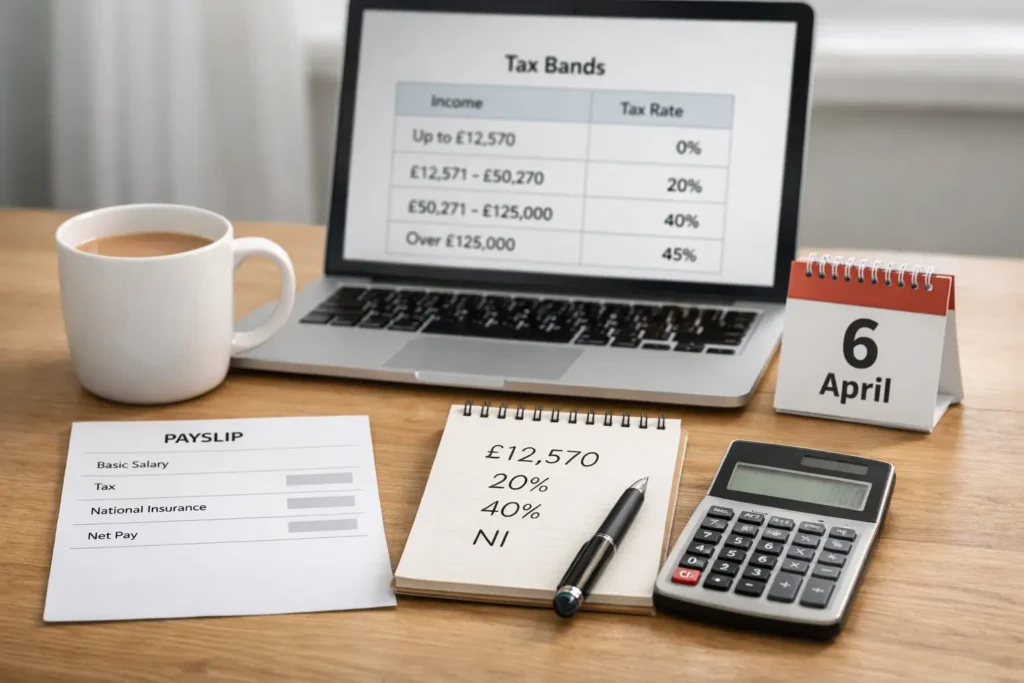
You get a pay rise, you feel pleased for about five minutes… then your take-home pay barely moves. Sound familiar? For many UK employees, sole traders and landlords, the “why” sits in a handful of numbers that quietly bite from 6 April: the Income Tax bands, the National Insurance thresholds, and the allowances that decide what’s taxed at 0%, 20%, 40% (or more).
This guide is a fact-led walkthrough of UK Tax rates, tax thresholds, tax bands, and tax allowances for the 2026/27 and 2025/26 tax years, with clear tables and worked examples you can sanity-check against your own income. We’ll cover England/Wales/Northern Ireland and Scotland (which is different), explain how marginal tax really works, and show realistic take-home pay scenarios — including the £100,000 “tax trap”.
If you want clarity (not jargon), you’re in the right place.
Table of Contents
ToggleQuick Answer Box
- Personal Allowance: £12,570 for 2025/26 and 2026/27 (standard cases).
- England/Wales/Northern Ireland Income Tax: 20% basic rate up to £50,270, 40% up to £125,140, 45% above that (same across both years).
- Scotland (non-savings, non-dividend): different bands and rates; 2026/27 widens the starter/basic bands compared with 2025/26.
- Employee National Insurance (most employees): 8% on earnings between the Primary Threshold and Upper Earnings Limit, then 2% above (both years).
- Dividend allowance: £500 in both years, but dividend tax rates increase in 2026/27 (ordinary 10.75%, upper 35.75%).
- Rule of thumb: your headline tax band is not the same as the rate you pay on every extra £1 — it’s usually a stack of different marginal rates.
Income Tax bands (England, Wales, Northern Ireland) for 2025/26 vs 2026/27
For England, Wales and Northern Ireland, the main Income Tax structure is unchanged between 2025/26 and 2026/27.
Bands and rates (standard Personal Allowance)
Taxable income means income after deducting your allowances (e.g., Personal Allowance).
| Band | Taxable income range | 2025/26 rate | 2026/27 rate |
| Personal Allowance | Up to £12,570 | 0% | 0% |
| Basic rate | £12,571 to £50,270 | 20% | 20% |
| Higher rate | £50,271 to £125,140 | 40% | 40% |
| Additional rate | Over £125,140 | 45% | 45% |
Sources: GOV.UK Income Tax rateshttps://www.gov.uk/income-tax-rates + Budget rates/allowances annexe.
How marginal tax works
You don’t pay one rate on all your income. You pay different rates on slices.
Mini example (England): £55,000 salary in 2026/27 (simplified)
- First £12,570: taxed at 0%
- Next £37,700 (to £50,270): taxed at 20%
- Remaining £4,730 (from £50,270 to £55,000): taxed at 40%
So only the top slice is hit at 40%. The rest is still 0%/20%.
Scottish Income Tax bands (non-savings, non-dividend income)
If you’re a Scottish taxpayer, Scotland sets different Income Tax rates and bands for non-savings, non-dividend income (think wages, self-employed profits, most rental profits, pensions). Dividends and savings rates follow UK-wide rules.
Who counts as a Scottish taxpayer?
In practice, it’s mainly about where your main place of residence is during the tax year (plus some special cases like Scottish Parliamentarians). HMRC treat “main place of residence” as a factual test — your strongest connection, not always just day-counting.
Scottish bands and rates (assuming standard £12,570 Personal Allowance)
The PAYE tables are published as “earnings above the PAYE threshold”, so the table below shows the more familiar total income ranges after adding the £12,570 allowance.
2025/26 (Scotland)
| Band | Total income range | Rate |
| Personal Allowance | Up to £12,570 | 0% |
| Starter | £12,571 to £15,397 | 19% |
| Basic | £15,398 to £27,491 | 20% |
| Intermediate | £27,492 to £43,662 | 21% |
| Higher | £43,663 to £75,000 | 42% |
| Advanced | £75,001 to £125,140 | 45% |
| Top | Over £125,140 | 48% |
2026/27 (Scotland)
| Band | Total income range | Rate |
| Personal Allowance | Up to £12,570 | 0% |
| Starter | £12,571 to £16,537 | 19% |
| Basic | £16,538 to £29,526 | 20% |
| Intermediate | £29,527 to £43,662 | 21% |
| Higher | £43,663 to £75,000 | 42% |
| Advanced | £75,001 to £125,140 | 45% |
| Top | Over £125,140 | 48% |
Personal Allowance and what happens after £100,000
The standard Personal Allowance
- Standard Personal Allowance is £12,570 in both 2025/26 and 2026/27.
- If your income is high enough, you can lose it (fully lost at £125,140 under current rules).
The £100,000 taper (the “tax trap”)
Once adjusted net income goes above £100,000, your Personal Allowance is reduced by £1 for every £2 over £100,000.
Worked example: Hannah in Leeds earns £112,000 (2026/27)
Assume Hannah has no salary sacrifice/pension contributions and has the standard allowance.
- Income over £100,000: £112,000 − £100,000 = £12,000
- Personal Allowance lost: £12,000 ÷ 2 = £6,000
- New Personal Allowance: £12,570 − £6,000 = £6,570
- Taxable income: £112,000 − £6,570 = £105,430
Why it feels brutal: in the taper zone, you’re not only paying higher-rate tax — you’re also losing 20% relief that the allowance would have given you. That’s why people talk about an effective 60% marginal Income Tax rate in that band (before National Insurance).
National Insurance
National Insurance (NI) is separate from Income Tax — it shows up on your payslip, and it’s a big reason pay rises can feel “smaller than expected”.
Main employee NI
For both 2025/26 and 2026/27 (as published in employer rates/thresholds guidance):
- 0% up to the Primary Threshold (aligned to £12,570/year)
- 8% between £12,570 and £50,270 (Upper Earnings Limit aligned to higher-rate threshold)
- 2% above £50,270
Employer NI
Most employers pay 15% above the Secondary Threshold (shown as £5,000/year in the published thresholds).
Payroll reality check
When you move into higher-rate Income Tax, the “headline” 40% is only part of the story. On that same slice of pay, you can also have NI at 2% (plus student loans, pension contributions, etc.). So the marginal hit to each extra pound can be higher than you expect — even if your overall/average rate is much lower.
Dividend allowance + dividend tax rates (and what changed in 2026/27 if applicable)
The dividend allowance
- Dividend allowance is £500 in both 2025/26 and 2026/27.
- It taxes the first £500 of dividend income at 0%, but the dividends still count when working out which band you’re in.
Dividend tax rates: 2025/26 vs 2026/27
| Your Income Tax band | 2025/26 dividend rate | 2026/27 dividend rate |
| Basic rate | 8.75% | 11% |
| Higher rate | 33.75% | 36% |
| Additional rate | 39.35% | 39% |
Worked example: Ben in Manchester gets £8,000 dividends (2026/27)
Assume:
- Ben has a £40,000 salary and £8,000 dividends
- Standard Personal Allowance, no other income
- Salary uses the Personal Allowance first. Taxable salary = £40,000 − £12,570 = £27,430
- Basic-rate taxable band is £37,700, so remaining basic band = £37,700 − £27,430 = £10,270
- Dividend allowance: first £500 at 0%
- Remaining dividends: £8,000 − £500 = £7,500
- All £7,500 sits inside Ben’s remaining basic band, so taxed at 10.75% = £806.25
Savings allowances (starting rate for savings + personal savings allowance)
There are two key “tax-free-ish” ideas for savings interest:
1) Starting rate for savings (up to £5,000 at 0%)
If your non-savings income is low, you may get up to £5,000 of savings interest taxed at 0%. Every £1 of other income above your Personal Allowance reduces that £5,000 starting rate by £1.
2) Personal Savings Allowance (PSA)
- £1,000 if you’re a basic rate taxpayer
- £500 if you’re a higher rate taxpayer
- £0 if you’re an additional rate taxpayer
Simple example: Aisha earns £16,000 and gets £200 bank interest (2026/27)
- Personal Allowance = £12,570, leaving other income of £16,000 − £12,570 = £3,430
- Starting rate savings band reduced by £3,430: £5,000 − £3,430 = £1,570
- Aisha’s £200 interest fits within that £1,570 band → 0% tax on the interest
Rule of thumb: lower earners can get a surprising amount of interest taxed at 0% once you combine the starting rate and PSA — but it depends on your non-savings income mix.
Key UK tax allowances people forget
These are often missed because they don’t look like “tax bands”, but they can materially change your bill.
- Marriage Allowance (transferable allowance)
You can transfer £1,260 of Personal Allowance to a spouse/civil partner if the transferor isn’t paying tax (or has unused allowance) and the recipient is not a higher/additional rate taxpayer. Maximum tax saving is typically £252 (20% of £1,260).
When it helps: one partner earns under the Personal Allowance and the other is a basic-rate taxpayer. - Blind Person’s Allowance
Extra tax-free amount added to your Personal Allowance: £3,130 (2025/26) and £3,250 (2026/27).
When it helps: you’re registered blind/severely sight impaired and you’re paying Income Tax. - ISA annual limit (why ISAs matter for tax planning)
ISA subscription limit: £20,000 for both 2025/26 and 2026/27.
When it helps: interest/dividends/capital gains inside ISAs are generally tax-free, which matters more as allowances get squeezed. - Gift Aid + pension contributions (high-level, not advice)
Gift Aid donations and pension contributions can reduce “adjusted net income” — which can be particularly valuable around £100,000 because it may preserve some Personal Allowance. (How it applies depends on circumstances; consider professional advice.)
Take-home pay examples
Important disclaimer: these are simplified illustrations for employees on a standard tax code with no student loans, no salary sacrifice, no benefits in kind, and no pension contributions. Real life can differ.
Example A: Jamie earns £32,000 (employee)
Assume 2026/27, England/Wales/NI.
- Personal Allowance: £12,570
- Taxable pay: £32,000 − £12,570 = £19,430
- Income Tax: 20% × £19,430 = £3,886.00
- Employee NI: 8% × £19,430 = £1,554.40
Estimated take-home: £32,000 − £3,886.00 − £1,554.40 = £26,559.60
Example B: Priya earns £62,000 (higher-rate exposure)
Assume 2026/27, England/Wales/NI.
- Taxable pay: £62,000 − £12,570 = £49,430
- Income Tax:
- 20% on £37,700 = £7,540.00
- 40% on £11,730 (£49,430 − £37,700) = £4,692.00
- Total = £12,232.00
- 20% on £37,700 = £7,540.00
- Employee NI:
- 8% on £37,700 = £3,016.00
- 2% on £11,730 = £234.60
- Total = £3,250.60
- 8% on £37,700 = £3,016.00
Estimated take-home: £62,000 − £12,232.00 − £3,250.60 = £46,517.40
Example C: Oliver earns £110,000 (Personal Allowance taper)
Assume 2026/27, England/Wales/NI.
Step 1 — adjust the Personal Allowance
- Income over £100,000: £10,000
- Allowance lost: £10,000 ÷ 2 = £5,000
- New Personal Allowance: £12,570 − £5,000 = £7,570
Step 2 — Income Tax
- Taxable pay: £110,000 − £7,570 = £102,430
- 20% on £37,700 = £7,540.00
- 40% on £64,730 = £25,892.00
- Total Income Tax = £33,432.00
Step 3 — Employee NI
- 8% on £37,700 = £3,016.00
- 2% on £59,730 (£110,000 − £50,270) = £1,194.60
- Total NI = £4,210.60
Estimated take-home: £110,000 − £33,432.00 − £4,210.60 = £72,357.40
Key point: between £100k and £125,140, losing the allowance can make extra income feel disproportionately taxed — this is where tax planning (especially pensions/salary sacrifice) is often explored.
What changed from 2025/26 to 2026/27?
Here’s the headline: a lot stayed frozen, and that matters.
What stayed the same
- Personal Allowance stayed at £12,570.
- England/Wales/NI Income Tax bands and rates stayed the same.
- Dividend allowance stayed at £500.
- ISA limit stayed at £20,000.
What did change
- Dividend tax rates increased in 2026/27 (ordinary and upper rates each up 2 percentage points).
- Scotland widened its starter/basic bands for 2026/27 (rates stayed the same, but the bands moved).
- Some NI thresholds ticked up (e.g., Lower Earnings Limit rises from £6,500 to £6,708 per year), while key ones stayed aligned.
- Blind Person’s Allowance increased to £3,250 in 2026/27.
Why freezes still hurt: fiscal drag
Fiscal drag is when your pay rises with inflation, but tax thresholds don’t. You haven’t become “richer” in real terms, but more of your income gets pulled into higher bands.
Quick illustration:
If your salary rises from £49,000 to £52,000 while thresholds are frozen, you may suddenly have part of your pay taxed at 40% (plus NI). Nothing “special” happened — you just crossed a static line.
FAQ
1) How do UK tax bands work?
Tax bands apply different rates to different slices of your taxable income. You typically pay 0% on income covered by allowances, then 20% on the next slice, then 40%, then 45% (England/Wales/NI). Scotland uses different bands for non-savings, non-dividend income.
2) Do I pay 40% on all my income if I’m a higher-rate taxpayer?
No. You only pay 40% on the portion of taxable income above the higher-rate threshold (after allowances). The earlier slices are still taxed at 0% and 20%. That’s why someone can be a “higher-rate taxpayer” but still have an average tax rate far below 40%.
3) What’s the personal allowance and when do I lose it?
The Personal Allowance is the amount you can earn before paying Income Tax (standard £12,570). If your adjusted net income exceeds £100,000, the allowance tapers away by £1 for every £2 over £100,000, and it’s fully removed at £125,140.
4) Are Scotland tax bands different?
Yes. If you’re a Scottish taxpayer, Scotland sets different rates and bands for non-savings, non-dividend income. Your tax code often starts with “S” under PAYE. Dividends and savings rates still follow UK-wide rules.
5) What’s the difference between a tax threshold and a tax allowance?
A tax allowance is usually an amount of income taxed at 0% (like the Personal Allowance). A threshold is a line where the rate changes or a rule starts applying (like the £50,270 higher-rate threshold or the £100,000 allowance taper point).
6) How do dividends get taxed in 2026/27?
In 2026/27, you still get a £500 dividend allowance taxed at 0%, but dividends above that are taxed based on your band. The ordinary and upper dividend rates rise to 10.75% and 35.75% respectively (additional rate remains 39.35%).
7) What’s the National Insurance rate in 2025/26?
For many employees (category A), NI is 0% up to the Primary Threshold, then 8% up to the Upper Earnings Limit, then 2% above. Employers typically pay 15% above the Secondary Threshold.
8) Are Income Tax thresholds frozen in 2026/27?
For England/Wales/Northern Ireland, the main bands and rates shown in official tables are unchanged between 2025/26 and 2026/27. That “freeze” is what drives fiscal drag: pay rises can push more income into higher rates even if rates themselves don’t move.
9) Does the dividend allowance reduce my taxable income?
Not exactly. The allowance applies a 0% tax rate to the first £500 of dividend income, but the dividend income still counts when working out which band you’re in. So it can still push you into a higher band even if the first £500 is taxed at 0%.
10) How does the Personal Savings Allowance work?
If you’re a basic-rate taxpayer you can typically earn £1,000 of savings interest tax-free; if you’re higher-rate, £500; if you’re additional-rate, £0. On top of that, some lower earners can also benefit from the 0% starting rate for savings (up to £5,000, reduced as other income rises).
11) What’s “adjusted net income” and why do people mention it?
Adjusted net income is the figure HMRC use for certain rules, including the Personal Allowance taper above £100,000. Some reliefs (like pension contributions and Gift Aid) can reduce it, which may preserve allowances. The precise calculation can be nuanced, so it’s worth checking HMRC guidance or getting advice.
12) If I live in Scotland but work in England, do I pay Scottish tax?
Often yes — the key factor is usually your main place of residence and whether you’re a Scottish taxpayer for that tax year, not where your employer is based. PAYE normally reflects this via an “S” prefix in your tax code once HMRC determine your status.
Conclusion
If you’ve skimmed the tables and examples, you’ve already got the main win: UK tax is about slices (marginal rates), not one scary headline percentage. For 2025/26 and 2026/27, many of the big numbers are unchanged, which can still increase your tax over time through fiscal drag — while 2026/27 notably raises dividend tax rates and tweaks some Scottish bands and selected allowances.
Next steps that actually help:
- Check your tax code (and question it if it looks wrong).
- If you’re near £50,270 or £100,000, model the impact before you accept a pay change or dividends.
- Consider speaking to an accountant if you have multiple income sources (employment + property + dividends).
And if you want one place to keep coming back to, bookmark this guide to UK Tax rates, tax thresholds, tax bands, and tax allowances for the 2026/27 and 2025/26 tax years