
It is the 19th and you are checking the month’s CIS figures. There are subcontractors on your records, perhaps several have already been verified, but nobody was actually paid during the relevant CIS tax month. Does “nothing paid” mean “nothing to file”?
Usually, no.
Under the CIS nil return rule 2026, a mainstream contractor that has made no subcontractor payments normally needs to file a nil return or have an appropriate period of inactivity recorded with HMRC. The rules changed from 6 April 2026, when the legal requirement for mainstream contractors to make nil returns was reinstated.
The detail matters, though. A month with no subcontractor payments is different from paying a subcontractor under gross payment status with a £0 deduction. Temporary inactivity is different again. And if your business has stopped acting as a contractor altogether, repeatedly filing nil returns may not be the right long-term answer.
Short answer
If you are a mainstream CIS contractor and paid no subcontractors during the CIS tax month, you should normally file a nil return by the 19th unless HMRC has recorded a period of inactivity. Having no subcontractors at all does not, by itself, mean you can ignore an active CIS scheme. Different wording applies to deemed contractors, which is explained below.
What is the CIS nil return rule in 2026?
Direct answer: From 6 April 2026, mainstream contractors who have not paid subcontractors in a CIS tax month are again required to deal with that month by filing a nil return or notifying HMRC of a period of inactivity. The change reinstated a nil-return obligation that had previously been removed in 2015.
The change was made through the Income Tax (Construction Industry Scheme) (Amendment) Regulations 2026, which came into force on 6 April 2026. HMRC said the earlier removal of mandatory nil filing had resulted in contractors receiving erroneous late-filing penalties because HMRC did not know that no payments had been made.
For most construction businesses, the practical decision is now straightforward:
- if subcontractors were paid, file a return showing those payments;
- if no subcontractors were paid, file a nil return;
- if you expect no subcontractor payments for a period, consider an inactivity request.
HMRC’s current detailed guidance adds an important qualification for deemed contractors. CIS 340 says deemed contractors with no subcontractor payments are not legally required to file a nil return, but HMRC expects them to notify it by filing a nil return or reporting inactivity. If they do neither, HMRC says it will issue a penalty; where the deemed contractor then tells HMRC that no subcontractors were paid, HMRC says the penalty will be cancelled.
That distinction is worth knowing because some broader HMRC communications published in 2026 refer generally to “CIS contractors” having to make monthly returns, while the more detailed current CIS 340 guidance expressly distinguishes mainstream from deemed contractors. For a deemed contractor with unusual circumstances, check the specific position rather than assuming a headline summary applies in exactly the same way.
For HMRC’s current filing instructions, see HMRC’s guidance on filing CIS monthly returns.
Do I need to file CIS if I have no subcontractors?
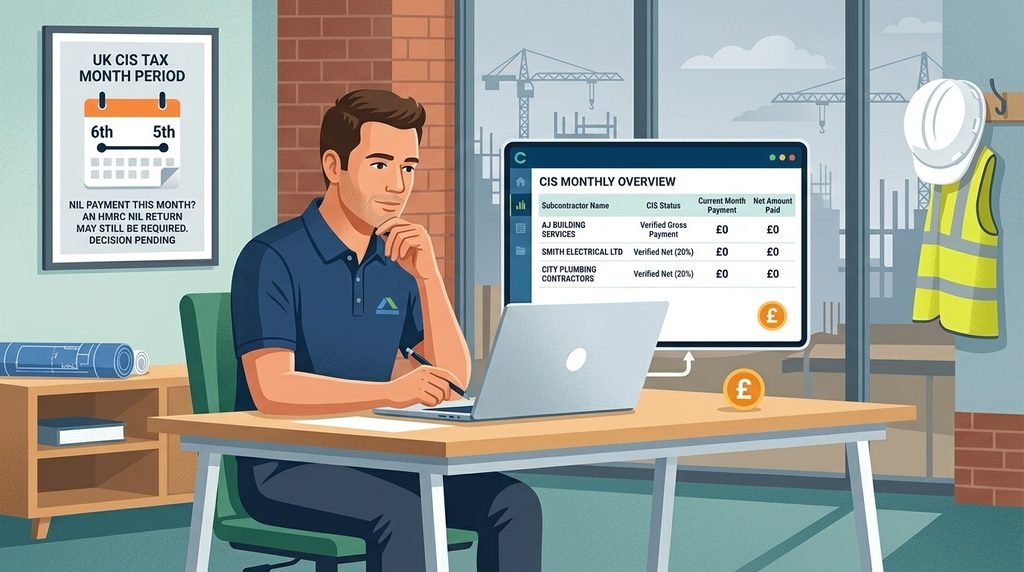
Direct answer: If you are a mainstream contractor, having no subcontractors during a particular month normally means you made no subcontractor payments. If your CIS scheme remains active, file a nil return by the normal deadline unless an inactivity period is already in place. If you have stopped using subcontractors altogether, tell HMRC rather than simply allowing returns to become overdue.
This is the point behind the common search question “do I need to file CIS if no subcontractors”: CIS reporting is not switched off automatically merely because your site was quiet.
Imagine a refurbishment company that had three subcontractors verified earlier in the year. During the tax month from 6 September to 5 October 2026, none of the three is paid. The fact that their details remain in the bookkeeping system does not itself create a reportable payment. For a mainstream contractor, the month is a nil month and should normally be dealt with by 19 October 2026, unless an inactivity request applies.
Previously verifying somebody does not mean that person has to appear as a payment every month. HMRC’s monthly return is concerned with payments actually made. If a previously used subcontractor has not appeared on a CIS return in the current or previous two tax years, however, HMRC may require verification again before a later payment is made.
Do I need to file CIS if I paid no subcontractors this month?
Direct answer: For a mainstream contractor, yes, unless HMRC has recorded an applicable period of inactivity. A month in which no subcontractor payments were made is normally dealt with by filing a nil CIS return. Do not assume that an absence of bank payments automatically removes HMRC’s monthly filing expectation.
What counts as a “nil” CIS month?
A genuine nil month is a CIS tax month in which the contractor has made no reportable payments to subcontractors.
The word payments is important.
CIS 340 describes a payment broadly as anything paid out under a construction contract and says payments can include cash, cheques and certain credits, advances, subs and loans. The return is therefore driven by payments rather than simply by whether a subcontractor has issued an invoice.
Suppose an electrician sends a contractor an invoice dated 30 September, but the contractor does not make the relevant payment until 10 October. The invoice date alone does not make it a September CIS payment. The contractor needs to identify when a CIS payment, as defined by HMRC, was actually made.
This is one reason bookkeeping cut-off procedures matter. Looking only at an invoice report can produce the wrong CIS answer.
A nil month can still exist even where:
- subcontractors remain on the supplier ledger;
- subcontractors were verified previously;
- unpaid subcontractor invoices are waiting for payment;
- construction work is temporarily between stages.
But check all payment routes before declaring the month nil. A payment may have come from a second bank account, a director’s payment card or another part of the bookkeeping system.
CIS nil return rules at a glance
| Point | 2026 position |
| CIS tax month | Runs from the 6th of one month to the 5th of the next. |
| Normal monthly filing deadline | The return must reach HMRC by the 19th following the end of the tax month. |
| Mainstream contractor with no subcontractor payments | File a nil return or notify HMRC of an appropriate period of inactivity. The nil-return obligation was reinstated from 6 April 2026. |
| Temporary inactivity | An inactivity request normally lasts for up to six months and can be renewed. |
| Standard CIS deduction rate | 20% for registered subcontractors where HMRC instructs payment under the standard deduction. |
| Higher deduction rate | 30% for relevant unregistered or unmatched subcontractors. |
| Gross payment status | The contractor applies a 0% deduction, but a payment has still been made and must be reported where it falls within CIS. |
| CIS records | Keep required CIS records for at least three years after the end of the tax year to which they relate. |
Nil return vs CIS inactivity: what is the difference?
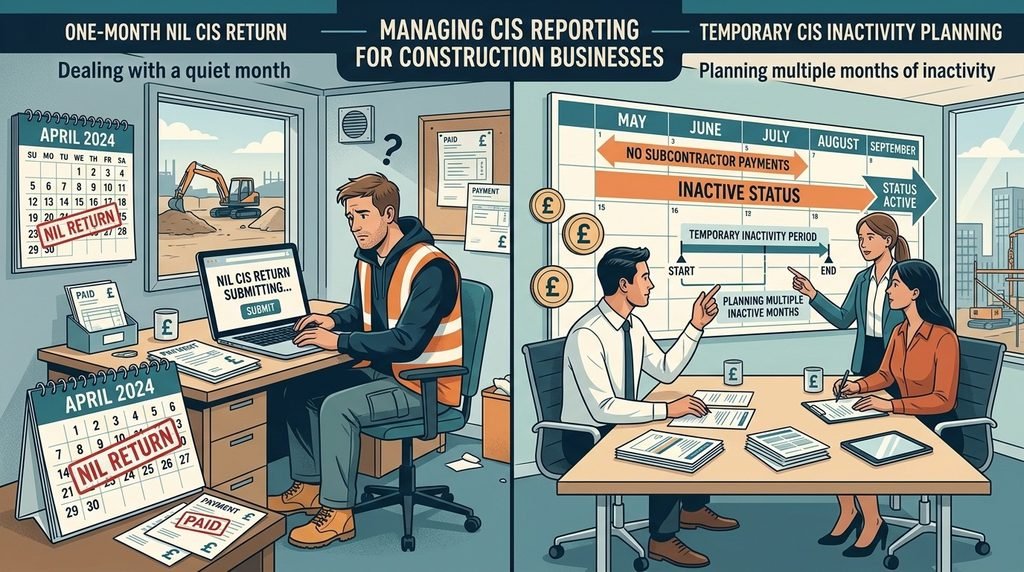
Direct answer: A nil return deals with a particular CIS tax month in which no subcontractor payments were made. An inactivity request tells HMRC that you expect not to make subcontractor payments for a temporary period, normally up to six months. Filing a return containing payments during that period brings the inactivity period to an end.
| Situation | Nil return? | Inactivity notification? | What the contractor should check |
| A. No subcontractor payments this month | Normally yes for a mainstream contractor | Optional if a longer gap is expected | Confirm no reportable payments were made in the 6th-to-5th tax month |
| B. No subcontractor payments expected for several months | The current nil month may need dealing with | Often the more practical option | HMRC normally permits temporary inactivity for up to six months |
| C. Subcontractor paid but CIS deducted at £0 | No | No, not for that payment month | Check whether gross payment status applies and report the payment |
| D. No subcontractors at all, but CIS scheme remains active | Usually yes for a mainstream contractor unless inactivity applies | Consider it if the position is temporary | Decide whether the business is merely quiet or has stopped using subcontractors |
| E. Business has stopped acting as a contractor | Do not simply keep filing nil returns indefinitely | Temporary inactivity may not describe the position | Tell HMRC if subcontractors have been stopped completely and the contractor reporting obligation should end |
For Situation E, HMRC’s public guidance says that if a business stops using subcontractors completely, it should tell HMRC and stop filing monthly CIS reports. That is different from a contractor that expects another subcontractor on site in three months’ time.
What if I paid a subcontractor but deducted no CIS tax?
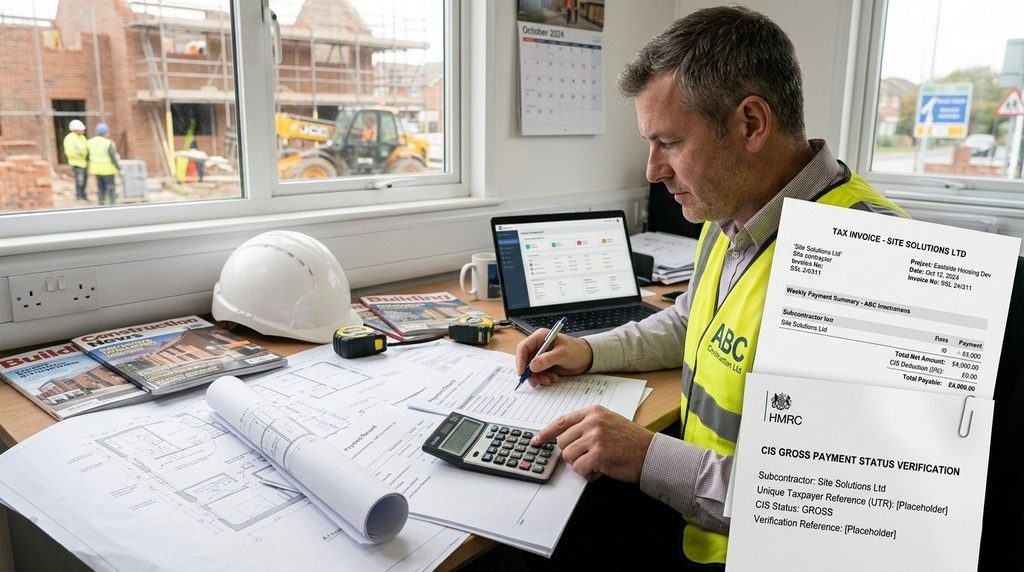
Direct answer: A £0 CIS deduction does not mean a nil CIS month. If a subcontractor with gross payment status is paid for reportable construction work, the contractor reports the payment even though no tax is deducted. HMRC expressly requires monthly returns to include subcontractors paid gross as well as those paid under the standard or higher deduction rates.
Consider this fictional example.
A verified subcontractor with gross payment status is paid a £4,000 reportable amount for construction work. HMRC’s verification tells the contractor to pay the subcontractor gross.
- CIS payment reported: £4,000
- CIS deduction: £0
- Nil return: No
There was a payment. The fact that the deduction happens to be zero does not turn it into a nil month.
Contrast that with a second contractor that has three verified subcontractors but pays all three £0 during the tax month. For a mainstream contractor, that is the type of month dealt with through a nil return or inactivity notification.
The same distinction helps with ordinary deductions. Suppose a registered subcontractor is paid £5,000 excluding VAT, of which £1,000 represents qualifying materials paid for by that subcontractor. If HMRC has instructed the contractor to apply the standard 20% rate, the illustrative deduction is 20% of £4,000 = £800. CIS deductions are calculated after relevant amounts such as qualifying materials are dealt with under HMRC’s rules.
What dates does a CIS monthly return cover?
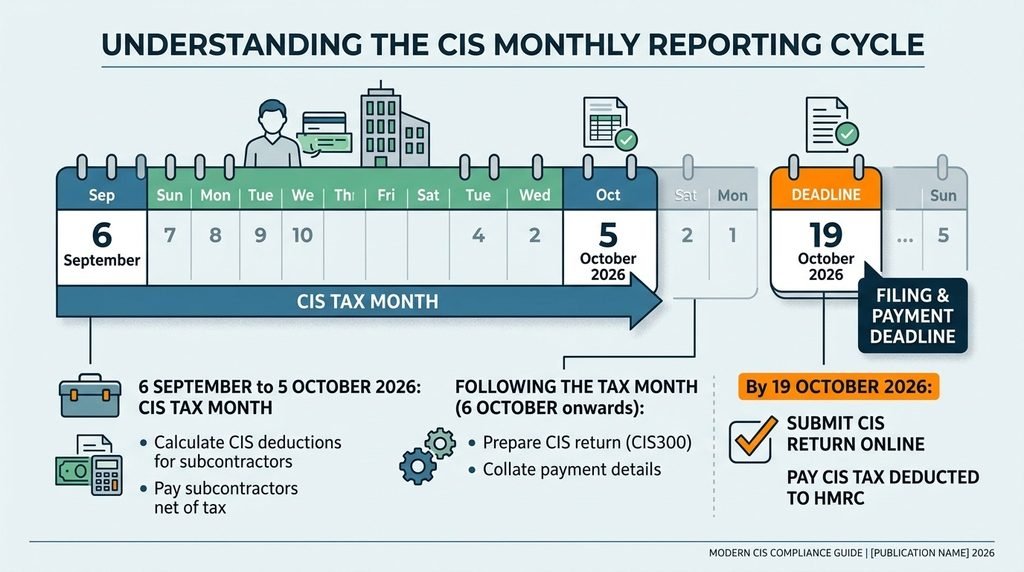
Direct answer: A CIS tax month runs from the 6th of one calendar month to the 5th of the next. It does not follow an ordinary calendar month. That means payments made on the 5th and 6th fall into different CIS reporting periods.
For example:
6 September to 5 October 2026 is one CIS tax month.
A reportable subcontractor payment made on 5 October belongs in that return. A reportable payment made on 6 October falls into the following CIS tax month.
That cut-off is easy to miss when bookkeeping reports are produced from the first to the last day of the calendar month.
Bloom Financials already has a separate explanation of the CIS monthly return deadline and filing cycle for contractors who need more detail on monthly timing.
When is the CIS return due?
Direct answer: A contractor’s monthly CIS return is normally due to HMRC by the 19th following the end of the CIS tax month. For the tax month running from 6 September to 5 October 2026, the filing deadline is 19 October 2026.
This filing date should not be confused with the deadline for paying CIS deductions to HMRC. HMRC says deductions are generally paid by the 22nd when paying electronically, or the 19th when paying by post, as part of the PAYE/CIS payment arrangements.
That distinction can matter where a company operates both employees and subcontractors. HMRC may combine an existing PAYE scheme with CIS, but the return and payment obligations still need to be handled correctly.
What happens if I forget to file or notify HMRC?
Direct answer: HMRC’s current late-return schedule starts with a £100 penalty when a return is one day late, followed by £200 at two months. At six months, the penalty is the greater of £300 or 5% of the CIS deductions on the return, with further penalties possible at 12 months and beyond.
For returns outstanding for longer periods, HMRC’s current public guidance also describes additional penalties and says a contractor may appeal a penalty within 30 days of the date on the penalty notice.
What happens if a CIS nil return is late?
For mainstream contractors, do not rely on the old assumption that a nil return cannot produce a meaningful penalty because the tax deduction is £0.
The 2026 reform deliberately reinstated the nil filing requirement for mainstream contractors. HMRC’s July 2026 CIS 340 guidance says that where a mainstream contractor has not paid subcontractors, it must file a nil return or notify HMRC of inactivity, and a penalty will be due if it does neither.
Some older HMRC material can be found stating that a penalty for a late nil return will be cancelled. That reflects the historical position and should not be treated as a blanket rule for mainstream contractors after 6 April 2026. The current public-facing guidance specifically confirms the reinstated obligation.
There is, however, a specific deemed-contractor nuance. Current CIS 340 says a deemed contractor with no subcontractor payments is not legally required to file a nil return, although HMRC will issue a penalty if the business neither files one nor reports inactivity. HMRC says it will cancel that penalty when the deemed contractor subsequently confirms that no subcontractors were paid.
If you already have a penalty notice, check the type of contractor, the relevant tax month and whether HMRC had been told about inactivity before deciding how to respond. Bloom Financials offers HMRC penalty appeal support, including reviewing the basis of a penalty and helping with supporting documentation and HMRC correspondence where appropriate.
Can I tell HMRC my CIS scheme is temporarily inactive?
Direct answer: Yes. If you temporarily stop using subcontractors and do not expect to make payments in the foreseeable future, HMRC allows an inactivity request lasting up to six months. It can be renewed. If you start paying subcontractors again, file a monthly return with the payments; HMRC says this ends the inactivity period.
A temporary gap is exactly what inactivity is designed for.
Imagine a contractor finishing one development in July and knowing the next subcontracted project will not begin until November. Filing individual nil returns month after month may be unnecessary if an appropriate inactivity period is recorded instead.
HMRC says an inactivity request can be made through the CIS online service when filing a nil return. If the online service cannot be used, HMRC also provides phone or postal routes. An ordinary inactivity request lasts for up to six months and can be renewed afterwards.
Deemed contractors that do not expect contract payments for a longer foreseeable period may be able to contact HMRC about a longer period.
For the official rules, see HMRC’s guidance on CIS inactivity and changes.
What should I check before submitting a nil CIS return?
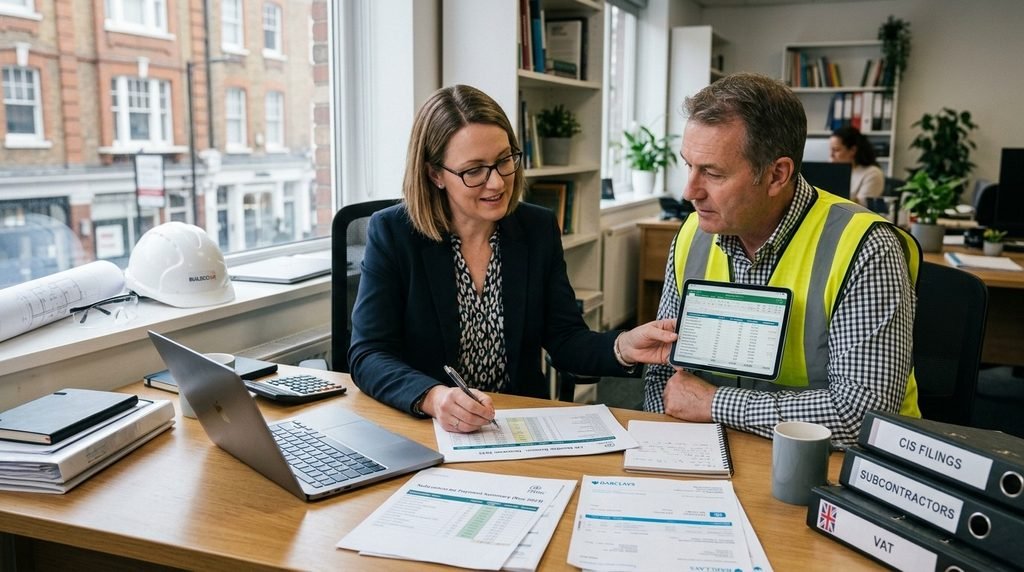
A nil declaration should follow a quick review of the month’s records rather than an assumption that “nothing happened”.
Check:
- Were any subcontractors actually paid? Review the full CIS tax month from the 6th to the 5th, not the calendar month.
- Was somebody paid gross? A gross-payment-status subcontractor still creates a reportable payment even though the deduction is £0.
- Are you looking only at invoices? CIS reporting concerns payments. An unpaid invoice is not the same thing as a payment, although HMRC’s definition of payment is broader than a simple bank transfer.
- Were payments made through another account? Check bank accounts, director-paid items and bookkeeping entries before declaring nil.
- Is the worker actually a subcontractor? Contractors must consider employment status. HMRC requires the monthly return to include a declaration that the subcontractors listed are not employees.
- Is the business temporarily inactive? If no payments are expected for several months, an inactivity request may be cleaner than repeated nil returns.
- Has the business permanently stopped using subcontractors? If so, tell HMRC rather than leaving an active scheme unattended.
Even in a nil month, existing CIS documentation should not be discarded. HMRC requires relevant CIS records to be retained for at least three years after the end of the tax year to which they relate.
Practical examples
Example 1 — Tom’s quiet refurbishment month
Tom runs a small refurbishment company and is registered as a mainstream CIS contractor. Three subcontractors have been verified, but none is paid between 6 September and 5 October 2026.
The presence of verified subcontractors does not make this a payment month.
Unless Tom has an applicable inactivity period in place, he should deal with the month as a nil return by 19 October 2026.
Example 2 — Four months between projects
A contractor completes a development and expects no subcontractor payments for approximately four months.
This is different from discovering after each month-end that business happened to be quiet. The contractor can consider asking HMRC to make the CIS scheme temporarily inactive. HMRC says an inactivity request normally lasts for up to six months.
If a new job starts earlier than planned and the contractor makes a CIS payment, the contractor files the payment return as normal and the inactivity period ends.
Example 3 — £4,000 payment, £0 deduction
A verified subcontractor with gross payment status is paid a reportable £4,000 during the tax month.
The contractor deducts £0, but this is not a nil month. HMRC requires payments to gross-status subcontractors to be included in the monthly return.
The distinction is simple:
£0 deduction is not the same as £0 payment.
Common CIS nil-return mistakes
One common mistake is using the calendar month instead of the CIS tax month. A payment on the 6th belongs to a different return from one made the day before.
Another is assuming that an unpaid invoice must be reported immediately because it appears in the purchase ledger. CIS reporting focuses on payments, although the statutory concept of a payment can include more than cash leaving a bank account.
Gross payment status causes another recurring error. Businesses sometimes see a £0 deduction and treat the entire return as nil. HMRC’s return rules make clear that gross payments still belong on the return.
There is also the opposite problem: continuing to file nil returns indefinitely when the contractor has actually stopped using subcontractors altogether. HMRC provides a separate route for notifying it when subcontractor use has ended.
Finally, do not assume that an old article saying nil-return penalties are automatically cancelled still describes the mainstream-contractor position in 2026. The law changed on 6 April 2026.
How Bloom Financials can help with CIS returns
A contractor with one straightforward quiet month may be able to resolve the reporting position themselves. But the administrative burden changes when a business has several subcontractors, different verification results, gross and net payments, materials, PAYE employees and a filing deadline every month.
Bloom Financials’ existing Construction Industry Scheme (CIS) Return service covers CIS return support, while its HMRC compliance offering includes CIS registration guidance, deduction management and monthly HMRC reporting.
Bloom’s broader Accounting Services include bookkeeping and payroll support as well as CIS returns. That can be useful where contractor payments, employee payroll and PAYE/CIS liabilities need to be reconciled rather than treated as separate pieces of administration.
Bloom Financials also advertises penalty-appeal support where a business has already received an HMRC penalty. Any appeal still depends on the facts and HMRC’s rules; professional support cannot guarantee that a penalty will be cancelled.
If you are uncertain whether the month is genuinely nil, whether inactivity is more appropriate or whether your contractor scheme should still be open, contact Bloom Financials to have the position reviewed before another deadline passes.
Frequently asked questions
Do I need to submit CIS every month if I have no subcontractors?
For a mainstream contractor with an active CIS reporting obligation, you should normally deal with every tax month. If no subcontractors were paid, that generally means filing a nil return unless HMRC has recorded a period of inactivity. If you have stopped using subcontractors altogether, tell HMRC so the scheme can be dealt with appropriately.
Is a nil CIS return the same as an inactivity request?
No. A nil return tells HMRC that no subcontractor payments were made for a specific CIS tax month. An inactivity request is forward-looking: it tells HMRC that subcontractor payments are not expected temporarily. HMRC says ordinary inactivity requests can last for up to six months and can be renewed.
What if I paid a subcontractor but deducted £0?
Report the payment if it is a reportable CIS payment. A subcontractor with gross payment status is paid without a CIS deduction, but HMRC still requires the contractor’s monthly return to include payments made gross. £0 deducted does not mean £0 paid.
What happens if I file a CIS nil return late?
For mainstream contractors, the reinstated 2026 nil-return requirement means you should not assume a late nil return is penalty-free. HMRC’s general late-return penalties start at £100, rising with the length of the delay. Current CIS 340 says a mainstream contractor that neither files a nil return nor reports inactivity can face a penalty.
How long can I make my CIS scheme inactive?
HMRC says a standard CIS inactivity request lasts for up to six months. You can renew it if the period without subcontractor payments continues. If you start paying subcontractors sooner, submit the relevant monthly return; HMRC says that return ends the inactivity period.
Do I need CIS if all my workers are employees?
Employee wages are dealt with through PAYE rather than by treating those workers as CIS subcontractors. HMRC says contractors must check whether a worker should be employed rather than subcontracted, and a CIS monthly return contains an employment-status declaration. If your business remains registered as a contractor but currently has no subcontractors, separately check whether a nil return, inactivity request or scheme-status change is required.
Can my accountant submit a CIS return for me?
Yes. HMRC allows authorised agents to manage CIS responsibilities for clients. Its PAYE for Agents service can be used to file clients’ monthly CIS returns and carry out subcontractor verification once the appropriate authorisation is in place.
Final takeaway
The safest way to think about the CIS nil return rule 2026 is to start with what was paid during the 6th-to-5th CIS tax month.
For a mainstream contractor, no subcontractor payments normally means a nil return is required unless HMRC has recorded an appropriate period of inactivity. A subcontractor paid under gross payment status is different: the deduction may be £0, but the payment still belongs on the return. And if your business has stopped using subcontractors completely, that is a scheme-status issue rather than simply another quiet month.
The rules changed on 6 April 2026, so older explanations of nil-return penalties may no longer describe the mainstream-contractor position correctly.
If your records do not make the answer obvious, ask Bloom Financials to review your CIS position, help with your next monthly return or assess an HMRC penalty notice before you act.
This article provides general information based on HMRC guidance available at the time of review. CIS treatment can depend on the contractor’s status, the nature of the payment and the underlying contractual arrangements.