
Imagine opening an HMRC letter in September and discovering that the Making Tax Digital decision you thought you could deal with later has effectively been made for you.
That is now a realistic prospect for some sole traders and landlords. On 12 August 2026, HM Revenue & Customs (HMRC) announced that, from September, it will begin signing up people who should already be using Making Tax Digital (MTD) for Income Tax for the 2026/27 tax year but have not registered themselves. The process will take place in stages over the following months.
The widely reported 294,000 figure needs some explanation. HMRC previously estimated that around 864,000 people would fall into the first MTD population. Its latest announcement says more than 570,000 customers have now signed up. Comparing those two rounded figures produces a gap of roughly 294,000, rather than a separate official HMRC count of exactly 294,000 unregistered taxpayers.
For anyone with more than £50,000 of qualifying income from self-employment and property, the bigger issue isn’t the letter itself. MTD has already applied since 6 April 2026, and the first quarterly update deadline passed on 7 August 2026. Automatic registration does not organise your bookkeeping, choose software or submit missing information for you.
HMRC to automatically sign up 294,000 taxpayers for MTD for Income Tax is therefore less a story about registration than about what happens when taxpayers are registered but operationally unprepared.
The bottom line
HMRC says it will begin signing up unregistered taxpayers from September 2026 where it believes they should already be using MTD for Income Tax in 2026/27. More than 570,000 customers had registered and more than 436,000 had submitted their first quarterly update by HMRC’s 12 August announcement. The first group covers qualifying sole traders and landlords with more than £50,000 of qualifying income, based on the relevant earlier tax return. If that includes you, it is sensible to check your position, software, digital records and outstanding quarterly update now rather than wait for HMRC.
What has HMRC actually announced?
From September 2026, HMRC will start signing up people it believes were required to join MTD for Income Tax from 6 April 2026 but have not yet done so. The exercise will be phased over several months. It is aimed at the first mandatory MTD cohort, not everyone who may become subject to the regime in later years.
HMRC’s announcement is notable because registration can no longer be treated as a task that remains entirely in the taxpayer’s hands.
People can still sign up for MTD themselves through GOV.UK. HMRC specifically says that doing so now gives taxpayers an opportunity to check their MTD information and prepare rather than waiting to be contacted.
There is still an important unknown. As at 17 August 2026, HMRC says further guidance will be published in late August explaining what taxpayers should do after receiving notification that HMRC has signed them up. The detailed official process has therefore not yet been published and should not be guessed at.
That matters because HMRC’s records are based partly on historic Self Assessment information. If your circumstances have changed — perhaps a property business or trade has ceased — you should check the position rather than assume HMRC’s registration automatically proves that every underlying detail is still correct. Current GOV.UK guidance specifically tells taxpayers to contact HMRC if they disagree that MTD applies to them.
Where does the 294,000 figure come from?
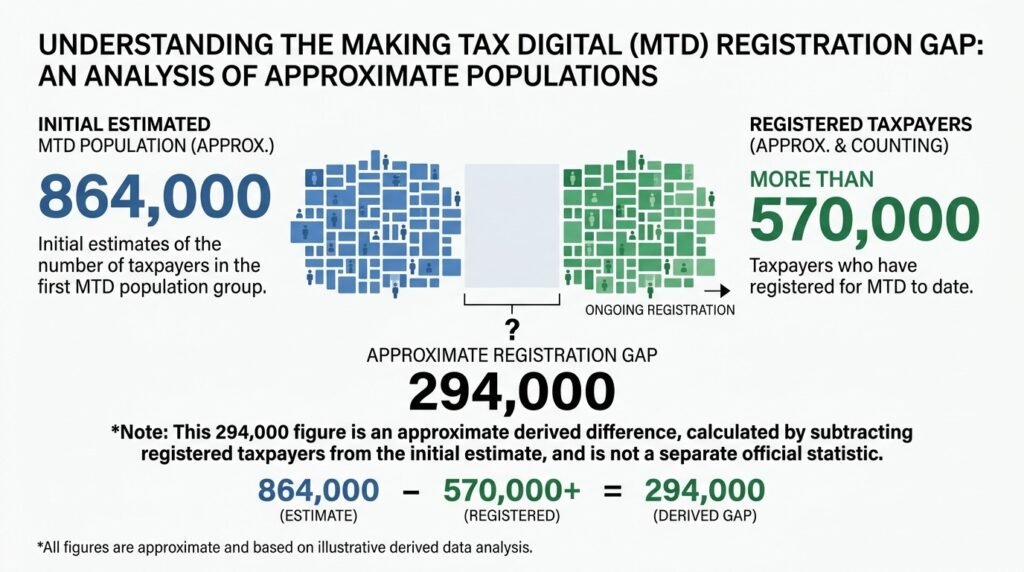
The 294,000 figure is best understood as an approximate registration gap. HMRC previously identified around 864,000 people with qualifying income above £50,000, while its 12 August 2026 announcement said more than 570,000 customers had registered. Subtracting 570,000 from 864,000 gives approximately 294,000.
| Figure | Approximate number | What it means |
| First-wave population estimate | 864,000 | HMRC statistical estimate of people with qualifying income over £50,000, based on earlier Self Assessment data |
| Registered by 12 August announcement | More than 570,000 | Customers signed up to MTD for Income Tax |
| Headline registration gap | About 294,000 | Derived comparison, not a separately stated exact HMRC count |
| First quarterly updates submitted | More than 436,000 | Successful first-quarter submissions reported by HMRC |
HMRC’s original 864,000 population figure was itself an estimate based on tax data rather than a live roll-call of every person actually required to comply in August 2026. The relevant official statistics used Self Assessment information and identified 864,000 individuals with qualifying income over £50,000.
So the safest editorial wording is “approximately 294,000”, with the calculation explained.
Who should already be using MTD for Income Tax?
For 2026/27, MTD for Income Tax generally applies to a sole trader or landlord registered for Self Assessment whose qualifying income for 2024/25 was more than £50,000, unless an exemption applies. Those taxpayers should have started using MTD from 6 April 2026.
The key word is qualifying.
A person can have total personal income considerably above £50,000 without necessarily being inside the first MTD group. Equally, someone whose taxable profit is well below £50,000 could still be caught.
That is because the test is based on qualifying gross income, not the profit left after deductible expenses.
What counts as qualifying income?
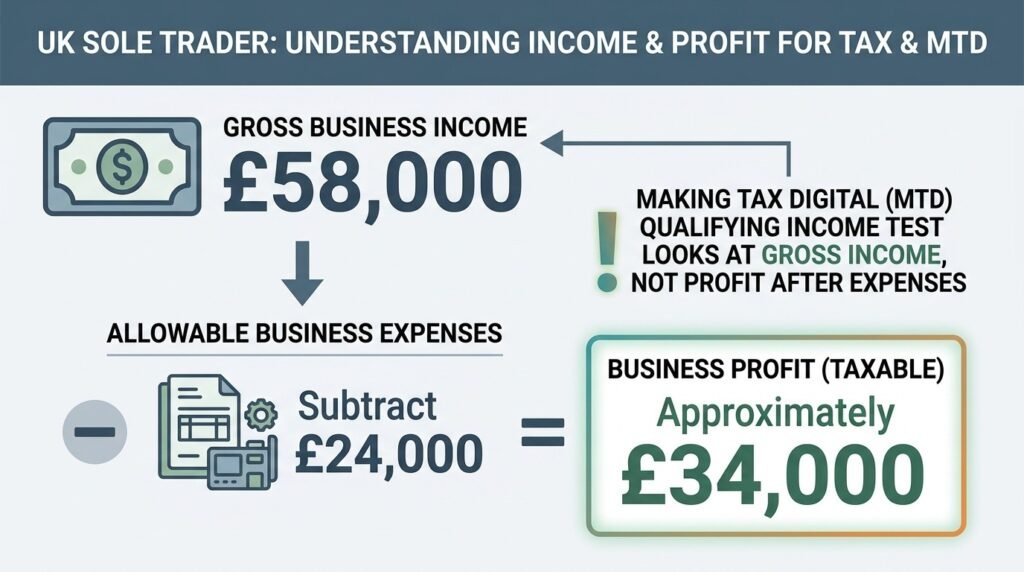
Qualifying income is your combined gross income from self-employment and property before expenses. PAYE employment income, dividends, State Pension, private pension income and an individual’s share of partnership profits do not count towards the MTD qualifying-income threshold.
For many sole traders, this is where things get confusing.
Suppose your business receives £58,000 during the relevant year but has £24,000 of allowable expenses. Your taxable business profit may be around £34,000 before considering other adjustments, but the MTD threshold test starts with the £58,000 gross self-employment income, not the £34,000 profit figure.
Property and self-employment income are also combined.
A simple mixed-income example
A hypothetical taxpayer has:
- £38,000 gross sole-trade income;
- £16,000 gross property income;
- £12,000 PAYE employment income.
Their MTD qualifying income would generally be £54,000: £38,000 plus £16,000. The PAYE salary does not enter the qualifying-income calculation. The £54,000 is considered before deducting business or property expenses.
HMRC itself gives a similar principle in its guidance: £25,000 of rental income plus £27,000 of self-employment income produces £52,000 of qualifying income.
For jointly owned property, it is generally your share of the property income that counts.
HMRC signs you up — but what happens next?
Automatic sign-up deals with registration. It does not complete the practical MTD work for you. You or your agent still need compatible software, digital records and quarterly updates, and the wider annual tax return process remains part of your obligations.
This distinction is probably the most important practical point in the announcement.
Being registered does not automatically:
- reconstruct missing bookkeeping;
- identify every business or property transaction;
- reconcile your bank account;
- categorise expenses correctly;
- choose suitable MTD-compatible software;
- create the necessary digital links where more than one system is used;
- submit an outstanding quarterly update;
- correct inaccurate historic information; or
- complete your annual Income Tax return.
HMRC requires affected taxpayers or their agents to use compatible commercial software to create, store and correct digital records, submit quarterly updates and ultimately submit the tax return. Software may maintain the records itself or, in some cases, connect to records such as spreadsheets through bridging software.
From a bookkeeping perspective, the software is only as reliable as the records feeding it.
A bank feed full of uncategorised payments isn’t finished bookkeeping. A spreadsheet with unexplained transfers isn’t automatically MTD-ready simply because bridging software can connect to it.
If HMRC signs you up, the useful response is therefore not simply “I’m registered now”. It is: “Are my records capable of meeting the obligations that registration has activated?”
Bloom Financials’ professional bookkeeping support includes transaction recording and reconciliation, while its accounting services include bookkeeping and cloud-accountancy support.
What if you missed the first quarterly update?
The first MTD quarterly update deadline for most taxpayers in the 2026/27 cohort was 7 August 2026. If you missed it, HMRC says you can still submit the update now. No penalty points are being applied for late quarterly updates during 2026/27, but the update remains a compliance requirement.
For most taxpayers, the first update covered 6 April to 5 July 2026. Taxpayers using calendar update periods had a first period running from 1 April to 30 June. Both had the same 7 August deadline.
The next standard quarterly deadline is 7 November 2026.
If you signed up late during the tax year, HMRC says you need to create the necessary digital records from the beginning of the relevant period and catch up.
You don’t want to discover this after another quarterly deadline has passed.
Are there penalties in 2026/27?
HMRC will not issue penalty points for late quarterly MTD updates in 2026/27. That easement does not remove the obligation to keep the required records and submit the updates, and it does not protect taxpayers from penalties associated with late tax returns or late tax payments.
There is a useful distinction here.
The first-year easement is a quarterly-update penalty concession, not a general tax-compliance holiday.
HMRC states that taxpayers must submit their quarterly updates before they can submit their tax return. Penalty points can still apply to late annual tax returns, while separate late-payment consequences can apply when tax is not paid on time.
That makes 2026/27 a sensible year to fix poor processes while one particular penalty pressure is temporarily reduced.
What changes from 6 April 2027?
From 6 April 2027, the MTD qualifying-income threshold falls to more than £30,000. The relevant test is qualifying income for 2025/26. The points-based regime will also apply to late quarterly updates after 2026/27.
Under that late-submission system, missing a quarterly deadline normally creates one penalty point. Once the four-point threshold is reached, a £200 fixed penalty is charged, with further £200 penalties possible for subsequent missed deadlines while the taxpayer remains at the threshold.
Someone with, say, £37,000 of relevant 2025/26 gross sole-trade income should therefore be preparing now even though they were outside the first £50,000 cohort.
What changes from 6 April 2028?
The next expansion begins on 6 April 2028 for sole traders and landlords whose qualifying income for 2026/27 is more than £20,000. This significantly broadens the population potentially required to use MTD for Income Tax.
HMRC’s earlier population statistics estimated that, based on 2023/24 data, around 2.9 million individuals had qualifying income above £20,000. Actual numbers in each mandatory cohort depend on the relevant year’s tax-return data.
For anyone hovering around £20,000 or £30,000, the useful question is no longer simply “Am I in MTD today?” It is “Will my records be ready by the tax year in which MTD becomes mandatory for me?”
MTD timetable at a glance
| MTD tax year | Qualifying-income test year | Threshold | MTD starts | Main affected group | Key point |
| 2026/27 | 2024/25 | Over £50,000 | 6 April 2026 | Sole traders and landlords | No penalty points for late quarterly updates during this first year |
| 2027/28 | 2025/26 | Over £30,000 | 6 April 2027 | Wider group of sole traders and landlords | Quarterly late-submission points regime applies |
| 2028/29 | 2026/27 | Over £20,000 | 6 April 2028 | Further expanded population | Threshold falls again |
HMRC’s current eligibility guidance confirms all three threshold-and-start-date combinations.
Does MTD replace Self Assessment?
No. MTD changes how affected self-employment and property records are maintained and reported during the year, but an annual tax return still has to be submitted. The normal annual deadline remains 31 January following the tax year.
For people who joined MTD on 6 April 2026, the 2025/26 Self Assessment return relates to the period before MTD started and remains due in the usual way by 31 January 2027.
The first annual MTD tax return covering 2026/27 is due by 31 January 2028.
Quarterly updates themselves are not four extra tax returns. They are summaries generated from the digital income and expense records.
Can you be exempt from Making Tax Digital?
Yes, but exemptions are specific. GOV.UK lists automatic and application-based exemptions, including circumstances involving digital exclusion. Simply preferring paper records, being unfamiliar with accounting software or finding MTD more expensive or time-consuming is not, by itself, enough to establish digital exclusion.
Examples of circumstances HMRC may consider for digital exclusion include a health condition, disability or age-related limitation that makes digital compliance unreasonable, religious objections to digital communications, or lack of practical internet access because of location. Applications are considered on their circumstances.
There are also other automatic and temporary exemptions, so the position can be more technical than the phrase “digitally excluded” suggests. Check HMRC’s current MTD exemption guidance rather than assuming an exemption applies.
Should you wait for HMRC to register you automatically?
If you know you are required to use MTD in 2026/27, there is usually little practical advantage in deliberately waiting for HMRC’s sign-up process. HMRC itself encourages affected taxpayers to register now so they can check their information and prepare rather than waiting to be contacted.
Proactive registration gives you more control over the operational work.
You can work out which income sources need records, choose suitable software, authorise your accountant where appropriate and identify missing bookkeeping before another deadline arrives.
There is one caveat: if you genuinely think HMRC has identified you incorrectly, or your circumstances involve an exemption or ceased income source, check that technical position first rather than blindly completing a registration you believe should not apply.
Accountant’s checklist: what to do now
If you are already inside the 2026/27 MTD cohort, or think you may be, work through these points:
- Confirm the threshold test. Review your 2024/25 gross self-employment and property income, not merely your taxable profit.
- Check every qualifying source. Include separate sole trades and your relevant share of property income.
- Review HMRC correspondence. If HMRC contacts you about automatic sign-up, compare its information with your current circumstances.
- Check whether any trade or property source has ceased. Contact HMRC where its historic information no longer reflects your position.
- Confirm your MTD registration status.
- Choose compatible software capable of meeting your actual needs, not simply the cheapest product on a list. HMRC provides a software-selection service.
- Bring your digital bookkeeping up to date. HMRC requires records of qualifying self-employment and property income and expenses.
- Reconcile bank transactions and investigate unexplained entries.
- Check whether the first quarterly update has been filed. If not, catch up now.
- Put 7 November 2026 in the compliance calendar for the next quarterly deadline.
- Keep annual Self Assessment obligations in view. MTD has not removed them.
- Speak to an accountant where mixed income, exemptions, joint property, ceased businesses or historic records make the answer unclear.
Bloom Financials offers taxation and Self Assessment support, bookkeeping and broader compliance services that can be relevant where the registration issue is only one part of a more complicated record-keeping problem.
A practical example: sole trader + landlord income
Consider a hypothetical freelance consultant who had the following 2024/25 figures:
| Item | Amount |
| Gross consultancy income | £41,000 |
| Consultancy expenses | £14,000 |
| Gross rental income | £17,500 |
| Property expenses | £6,000 |
| PAYE income from a part-time job | £9,000 |
The consultant might initially focus on profits: £27,000 of business profit plus £11,500 of property profit.
That is the wrong starting point for the MTD threshold.
Their qualifying income is generally £58,500 — £41,000 gross consultancy income plus £17,500 gross property income. PAYE income does not count for this test. The expense deductions do not reduce the qualifying-income figure.
Assuming no exemption applies, that 2024/25 qualifying income would place the taxpayer above the first-wave £50,000 threshold and therefore within MTD from 6 April 2026.
This is exactly why checking profit alone can give the wrong answer.
What automatic MTD registration means for landlords
Landlords can fall into MTD based on property income alone or because property income combined with self-employment pushes total qualifying income above the relevant threshold. The threshold is not tested against rental profit after repairs, agent fees, finance costs and other expenses.
Once in MTD, landlords must maintain digital records of relevant property income and expenses. HMRC states that multiple UK properties are generally treated as one UK property business for MTD record-keeping purposes, although records still need to support accurate income and expense reporting.
For a landlord already juggling several properties, the practical risk is often not registration but inconsistent bookkeeping: missing invoices, unclear transfers, unreconciled rent receipts or personal expenditure mixed into property accounts.
Quarterly reporting makes those problems surface earlier.
What it means for sole traders and freelancers
A sole trader’s MTD threshold is based on gross self-employment income, combined with any qualifying property income. A freelancer with substantial turnover can therefore be caught even where allowable expenses leave a much lower taxable profit.
If you run more than one sole-trader business, HMRC’s digital-record guidance requires separate records and quarterly updates for each self-employment source.
That makes regular transaction categorisation and bank reconciliation more important than under the traditional habit of sorting everything out shortly before 31 January.
Bloom Financials’ existing MTD guidance for contractors and sole traders also explains the distinction between qualifying personal income and other forms of income.
What about limited company directors?
Being a company director does not by itself put you into MTD for Income Tax. PAYE employment income and dividends do not count towards the qualifying-income threshold. A director can, however, be caught personally if they also have qualifying sole-trade or property income.
For example, a director receiving salary and dividends from a limited company but no personal self-employment or property income would not normally meet the MTD Income Tax threshold because of those company payments alone.
A director who also owns rental property personally or runs a separate sole trade needs to examine those sources separately.
This distinction is particularly important because MTD for Income Tax should not be confused with MTD for VAT, which may already apply to a VAT-registered limited company.
How Bloom Financials can help with MTD for Income Tax
For some taxpayers, registering is the easy part. The more useful professional work is making sure the records and processes behind the registration actually function.
Bloom Financials provides services covering Self Assessment and taxation, bookkeeping and reconciliation, cloud-accountancy and wider accounting support, and MTD-related support for taxpayers and businesses.
That may be useful if you:
- do not know whether your income puts you inside the threshold;
- have received or expect an HMRC automatic-sign-up notice;
- have missed the first quarterly update;
- still rely on incomplete spreadsheets or manual records;
- have property and self-employment income;
- need transactions reconciled before an update can be prepared; or
- want your MTD and annual Self Assessment processes considered together.
Not sure whether your income puts you inside MTD for Income Tax? Bloom Financials can review your position, help organise your digital records and support compatible accounting processes and ongoing tax compliance. You can speak to Bloom Financials about your circumstances.
Frequently asked questions
Is HMRC really automatically signing people up for MTD?
Yes. HMRC announced on 12 August 2026 that from September it will begin signing up people who should already be using MTD for Income Tax in 2026/27 but have not registered. The process will happen in stages.
How many people still need to register?
Approximately 294,000 is a useful headline estimate based on the earlier 864,000 first-wave population and HMRC’s latest statement that more than 570,000 customers have registered. It should not be presented as an independently published exact HMRC count.
Does PAYE salary count towards the MTD threshold?
No. HMRC explicitly excludes employment income under PAYE from qualifying income. The threshold is based on relevant gross self-employment and property income.
Do I need MTD software if HMRC signs me up?
Yes. Registration does not replace the software requirement. You or your agent need compatible commercial software capable of maintaining or connecting to the necessary digital records and making the required submissions.
I missed 7 August. Should I still send the update?
Yes. HMRC says taxpayers who have not yet submitted their first quarterly update can still do so. No penalty points apply to late quarterly updates in 2026/27, but the reporting requirement remains.
Does receiving no HMRC letter mean I’m outside MTD?
No. HMRC’s guidance says taxpayers remain responsible for checking whether and when MTD applies even if they have not received a letter.
What should I check if HMRC signs me up but my circumstances have changed?
Check the income sources and historic tax-return information that may have led HMRC to identify you as in scope. In particular, consider whether a business or property source has ceased or whether an exemption may apply. GOV.UK says to contact HMRC if you disagree that you need to use MTD.
Can my accountant deal with MTD for me?
An authorised agent can carry out many MTD activities for a client, including sign-up and submissions, subject to HMRC authorisation and software requirements. Existing Self Assessment authorisation can be recognised for MTD, although clients still need to be signed up to the service.
Final thoughts
HMRC’s September sign-up programme changes the psychology of MTD.
Until now, an unregistered taxpayer might have felt that doing nothing simply postponed the issue. It no longer necessarily does. If HMRC believes you belong in the first mandatory cohort, it intends to start bringing unregistered taxpayers into the system itself.
But HMRC to automatically sign up 294,000 taxpayers for MTD for Income Tax should not be interpreted as HMRC taking over the taxpayer’s bookkeeping responsibilities.
You still need correct digital records. You still need compatible software. You still need quarterly updates. You still have an annual tax return and payment obligations.
For 2026/27, there is some breathing room because late quarterly updates do not attract penalty points. Use it constructively.
Check the threshold. Check your records. Catch up anything outstanding. And if the figures or income sources do not make sense, get the position reviewed before another quarter passes.
This article is for general information only and does not constitute personalised tax, accounting or legal advice. Tax rules and HMRC guidance can change. Check your circumstances against current GOV.UK guidance or obtain professional advice.