
Many UK businesses believe IR35 only affects contractors. However, a single incorrect employment status decision can create unexpected tax liabilities, compliance issues, and disputes between businesses and workers.
Whether you engage freelancers, consultants, or contractors through personal service companies (PSCs), understanding IR35 Assessments is essential. The rules determine whether a contractor should be treated as genuinely self-employed or whether the working arrangement is similar to employment for tax purposes.
For businesses, getting this wrong can mean unexpected PAYE and National Insurance obligations. For contractors, it can significantly affect how much tax they pay and how they structure their work.
At Bloom Financials, we regularly help businesses understand complex UK tax and compliance requirements, including contractor arrangements, employment status reviews, and HMRC risk management. This guide explains how IR35 works, who needs an assessment, and the practical steps businesses should take to remain compliant.
What are IR35 Assessments?
IR35 Assessments are reviews carried out to determine whether a contractor’s working arrangement falls inside or outside the UK off-payroll working rules.
The purpose of an IR35 Assessment is to establish whether a contractor working through their own limited company (often called a personal service company or PSC) is genuinely operating as an independent business or whether the relationship is effectively similar to employment.
The assessment focuses on the actual working relationship, not simply the wording of a contract.
For example, a contractor may have a contract stating that they are self-employed, but if in practice they:
- Work fixed hours controlled by the client
- Provide services personally without substitution rights
- Are integrated into the organisation like an employee
- Receive ongoing work similar to an employee role
then HM Revenue & Customs (HMRC) may consider the engagement to be employment-like.
An IR35 Assessment helps businesses understand the employment status position before problems arise.
What is IR35?
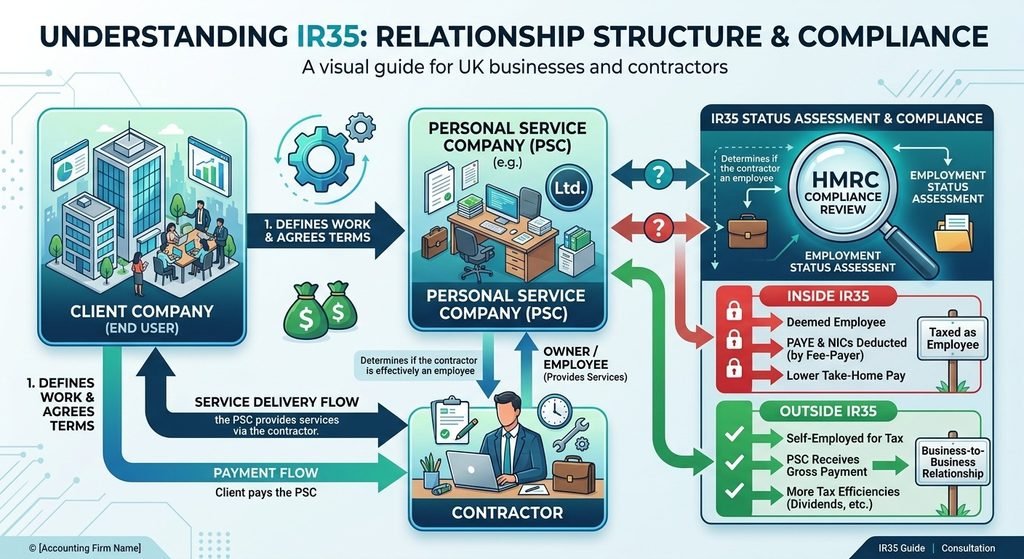
IR35 is UK tax legislation designed to prevent individuals from avoiding employment taxes by providing services through an intermediary company when the working arrangement is effectively employment.
The term “IR35” comes from the original Inland Revenue legislation introduced in 2000. Today, the rules are commonly referred to as the off-payroll working rules.
The legislation applies where:
- An individual provides services through an intermediary, such as a limited company
- The individual would have been considered an employee if they had provided the services directly to the client
The key question is:
“If the contractor worked directly for the client instead of through their company, would they be an employee?”
If the answer is yes, the engagement may fall inside IR35.
If the answer is no, the engagement may fall outside IR35.
Why Were IR35 Rules Introduced?
Before IR35, some individuals provided services through personal companies while working in roles that were very similar to employees.
By operating through a company, they could potentially pay themselves through a combination of salary and dividends rather than being taxed entirely through PAYE.
The government introduced IR35 legislation to ensure that workers who are effectively employees pay broadly similar employment taxes, even where they provide services through a limited company.
The rules do not prevent genuine contractors from operating through their own companies. Instead, they focus on whether the reality of the working relationship reflects genuine self-employment.
Who Needs an IR35 Assessment?
Any business engaging contractors through personal service companies should consider whether an IR35 Assessment is required.
The rules are particularly relevant for organisations that regularly use:
- IT contractors
- Software developers
- Project managers
- Engineers
- Consultants
- Interim managers
- Marketing specialists
- Healthcare professionals
- Financial specialists
- Freelancers operating through limited companies
Businesses should not assume that a contractor is outside IR35 simply because:
- They have their own limited company
- They have worked as a contractor for many years
- Their contract describes them as self-employed
- They invoice through a company
HMRC considers the full working arrangement.
Who Is Responsible for IR35 Compliance?
The responsibility depends on the size and type of organisation engaging the contractor.
Private Sector Businesses
For most medium and large private sector businesses, the responsibility for determining IR35 status generally sits with the organisation receiving the contractor’s services.
This means the client must:
- Assess the contractor’s employment status
- Decide whether the engagement is inside or outside IR35
- Provide an Employment Status Determination Statement (ESDS)
- Explain the reasons behind the decision
- Review the decision if circumstances change
The contractor and any agencies involved must also receive the determination.
Small Companies
Different rules may apply to small private sector companies.
Where the client qualifies as a small company under Companies Act criteria, the responsibility may remain with the contractor’s limited company.
Generally, a company may qualify as small if it meets at least two of the following conditions:
| Criteria | Threshold |
| Annual turnover | Not more than £10.2 million |
| Balance sheet total | Not more than £5.1 million |
| Average number of employees | Not more than 50 |
Businesses should review their position carefully because company size can affect IR35 responsibilities.
How Does an IR35 Assessment Work?
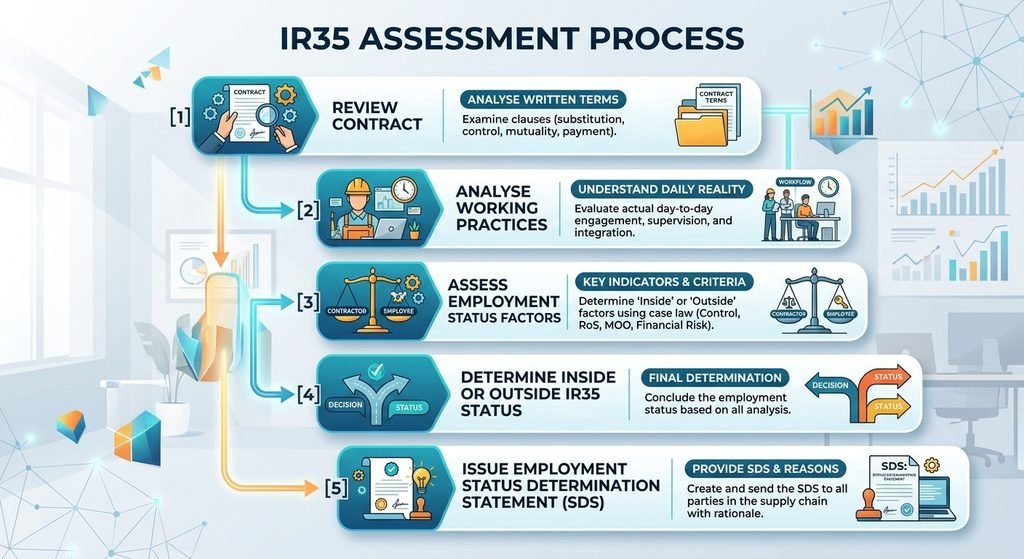
An IR35 Assessment involves reviewing the complete working relationship between the contractor and the client rather than looking only at the written contract.
A proper assessment normally considers several employment status factors.
1. Personal Service and Substitution
One of the important questions is whether the contractor must personally provide the services.
For example:
Outside IR35 scenario:
A software consultancy company agrees to deliver a project. It can provide another suitably qualified consultant if the original contractor becomes unavailable.
Inside IR35 risk scenario:
A contractor is personally hired because of their individual skills and cannot send someone else to complete the work.
The right of substitution is only meaningful if it reflects the real working arrangement.
2. Control and Direction
HMRC considers how much control the client has over the contractor.
Questions may include:
- Who decides how the work is completed?
- Who controls working hours?
- Does the contractor decide the method of delivery?
- Does the client supervise the contractor like an employee?
A contractor who controls how, when, and where services are delivered may have stronger evidence of self-employment.
3. Mutuality of Obligation
Mutuality of obligation considers whether the client is required to provide ongoing work and whether the contractor must accept it.
For example:
A contractor hired for a specific project with clearly defined deliverables may indicate a more independent relationship.
However, a contractor who receives continuous work, similar responsibilities, and employee-like expectations may face a higher IR35 risk.
4. Financial Risk
Genuine businesses usually take some level of financial risk.
Factors may include:
- Correcting defective work at their own cost
- Providing their own equipment
- Having professional insurance
- Marketing services to multiple clients
- Negotiating project fees
Employees generally do not carry these commercial risks.
5. Integration Into the Business
HMRC also considers whether the contractor is integrated into the organisation.
Indicators of higher employment risk may include:
- Appearing on internal staff structures
- Receiving employee benefits
- Managing permanent employees
- Using employee systems and processes
- Having a permanent position within the business
Inside IR35 vs Outside IR35: Key Differences
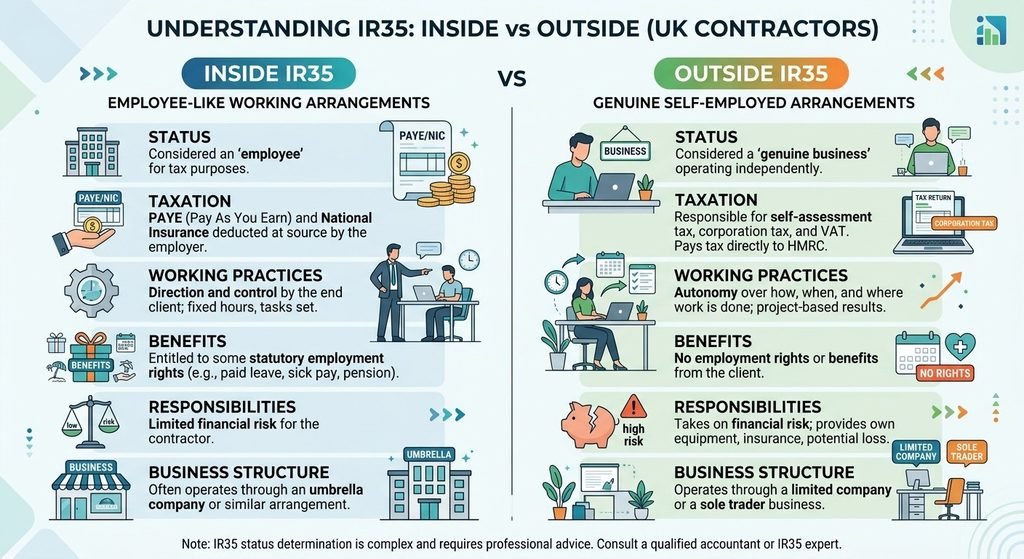
| Area | Inside IR35 | Outside IR35 |
| Employment status | Similar to employee for tax purposes | Genuine self-employed contractor |
| Tax treatment | PAYE and National Insurance may apply | Contractor manages own tax affairs |
| Client control | Higher level of direction and supervision | Contractor has greater independence |
| Working relationship | Employee-like | Business-to-business relationship |
| Risk level | Higher employment status risk | Lower IR35 risk if properly evidenced |
| Documentation | Detailed determination required | Evidence supporting decision recommended |
What Is an Employment Status Determination Statement (ESDS)?
An Employment Status Determination Statement (ESDS) is the formal document explaining the IR35 decision.
For organisations responsible for making the determination, the ESDS should:
- State whether the engagement is inside or outside IR35
- Explain the reasons behind the decision
- Be provided to relevant parties
- Demonstrate that reasonable care was taken
A simple statement saying “outside IR35” without supporting reasoning may not be sufficient if HMRC reviews the arrangement.
Why Reasonable Care Matters in IR35 Decisions
Businesses are expected to take reasonable care when making IR35 decisions.
This means organisations should not:
- Automatically classify every contractor as outside IR35
- Copy previous decisions without reviewing current arrangements
- Rely only on contract wording
- Ignore changes in working practices
A documented assessment process helps demonstrate that the business considered the relevant factors properly.
What Happens If IR35 Rules Are Ignored?

Ignoring IR35 requirements can expose businesses and contractors to significant tax and compliance risks.
The consequences depend on the circumstances, but businesses may face additional tax liabilities, interest, penalties, and increased scrutiny from HM Revenue & Customs (HMRC).
A common misconception is that IR35 problems only arise when a business deliberately avoids tax. In reality, many compliance issues occur because organisations have not properly reviewed contractor arrangements or have relied on outdated contracts.
A business may face problems where:
- Contractor roles have changed over time
- Working practices do not match written agreements
- IR35 decisions have not been documented
- Employment status assessments have not been regularly reviewed
- Contractors are treated like permanent employees despite operating through limited companies
Potential Tax Risks Under IR35
Where an engagement is determined to be inside IR35, the payments may need to be treated similarly to employment income.
Potential financial implications include:
PAYE Income Tax
The fee payer may need to account for PAYE income tax deductions from payments made for the contractor’s services.
Employer National Insurance Contributions
The organisation responsible for payment may also need to consider employer National Insurance liabilities.
Apprenticeship Levy
Some larger organisations may also need to consider whether additional employment-related liabilities apply.
Interest and Penalties
Where HMRC identifies incorrect treatment, interest and penalties may arise depending on the circumstances, including whether reasonable care was taken.
This is why maintaining proper documentation and evidence behind IR35 decisions is important.
How Does HMRC Check IR35 Compliance?
HMRC may review IR35 compliance as part of a wider employment status investigation or tax compliance check.
During a review, HMRC may consider:
- Contracts between parties
- Actual working arrangements
- Invoices and payment records
- Communication between the contractor and client
- Working hours and reporting structures
- Evidence of substitution rights
- Whether the contractor operates as an independent business
The key principle is that HMRC looks at the reality of the relationship, not just the paperwork.
A contract stating that someone is self-employed will not automatically determine their tax status if the day-to-day arrangement suggests otherwise.
Practical Example: Technology Contractor IR35 Assessment

Consider a UK technology company engaging a contractor through a personal service company.
The contractor:
- Provides software development services
- Works three days per week from the client’s office
- Uses the client’s equipment
- Reports directly to a department manager
- Has worked continuously for four years
- Cannot send a substitute
Although the contractor operates through a limited company, several factors may indicate an employment-like relationship.
The business should carry out an IR35 Assessment rather than assuming the arrangement is outside IR35.
Now consider a different situation:
A software consultancy company:
- Provides specialist development services
- Agrees a fixed project fee
- Controls how the work is delivered
- Uses its own equipment
- Can provide alternative qualified consultants
- Works with multiple clients
This arrangement may provide stronger evidence of a genuine business-to-business relationship.
Every case depends on the specific facts.
How Often Should Businesses Review IR35 Assessments?
IR35 decisions should not be treated as a one-off exercise.
Businesses should review contractor arrangements when there are significant changes, including:
- A change in responsibilities
- Contract extensions
- New working arrangements
- Changes in management structure
- Different payment arrangements
- A contractor becoming more integrated into the business
For example, a contractor originally hired for a six-month specialist project may have a different employment status position after working continuously for several years as part of the company’s core team.
How Much Does an IR35 Assessment Cost?
The cost of an IR35 Assessment varies depending on the complexity of the engagement and the level of review required.
A straightforward assessment may involve reviewing:
- Contractor agreements
- Working practices
- Business relationship factors
- Supporting documentation
More complex reviews may require:
- Multiple contractor assessments
- Detailed employment status analysis
- Policy reviews
- Risk management recommendations
Businesses should consider the cost of obtaining professional advice against the potential financial impact of an incorrect IR35 decision.
A properly documented assessment can provide valuable evidence that reasonable care was taken.
How Businesses Can Prepare for IR35 Compliance
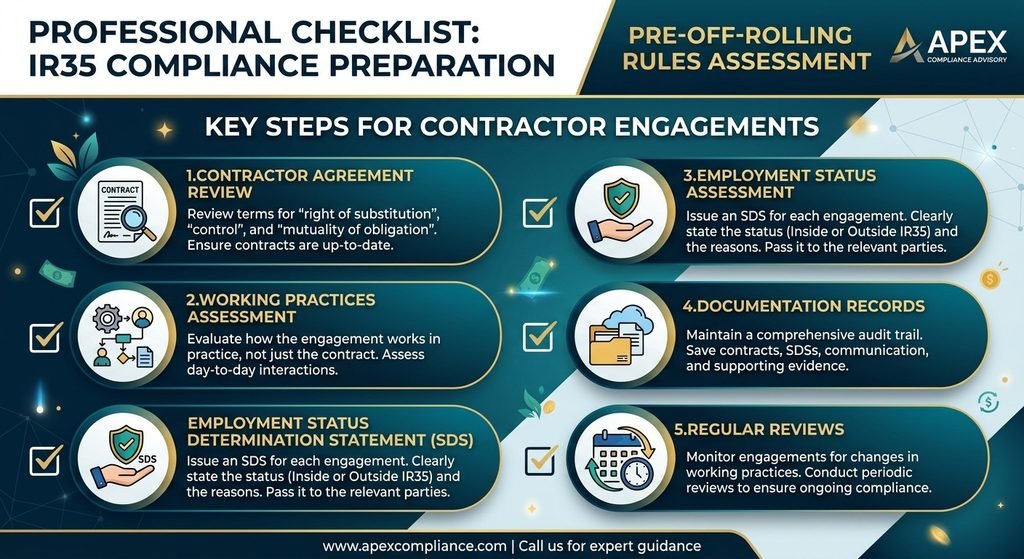
Businesses engaging contractors should consider implementing a structured approach.
1. Maintain Clear Contractor Agreements
Contracts should accurately reflect the intended working relationship.
Important areas may include:
- Scope of services
- Deliverables
- Payment terms
- Substitution clauses
- Responsibility for equipment
- Confidentiality obligations
However, the contract must reflect reality. A clause that is never used may carry limited weight.
2. Document IR35 Decisions
Businesses should retain evidence showing:
- How the decision was reached
- Factors considered
- Information provided by the contractor
- Reasons supporting the conclusion
This documentation can be valuable if HMRC later reviews the arrangement.
3. Review Existing Contractors
Many businesses focus only on new contractors, but existing arrangements may also create risk.
A practical review should identify:
- Long-term contractors
- Contractors working in employee-like roles
- High-value contractor engagements
- Contractors performing core business functions
4. Train Internal Teams
HR managers, finance teams, procurement departments, and hiring managers should understand their role in maintaining IR35 compliance.
Problems often occur when:
- Procurement negotiates contracts
- Managers control daily work
- Finance processes payments
but nobody owns the overall employment status review process.
Can Small Businesses Ignore IR35?
No. Small businesses should still understand IR35 principles.
While responsibility for determining status may differ for qualifying small companies, the underlying employment status rules remain relevant.
A small business engaging contractors should still consider:
- Whether the contractor relationship reflects genuine self-employment
- Whether contracts accurately represent working arrangements
- Whether future growth could change IR35 responsibilities
Good compliance practices from the beginning can prevent problems later.
Common IR35 Mistakes Businesses Make
Many IR35 issues arise from practical mistakes rather than intentional non-compliance.
Common examples include:
Assuming Limited Company Contractors Are Automatically Outside IR35
Operating through a limited company does not automatically mean a contractor is self-employed for tax purposes.
Relying Only on Contracts
A contract is important, but HMRC considers actual working practices.
Copying Previous IR35 Decisions
An assessment completed several years ago may no longer reflect the current arrangement.
Treating Contractors Like Employees
Examples include:
- Providing employee benefits
- Managing contractors in the same way as staff
- Requiring fixed attendance patterns
- Including contractors in internal structures
Failing to Keep Evidence
A decision without supporting documentation may be difficult to defend.
How Bloom Financials Can Help With IR35 Assessments

Understanding IR35 can be challenging because it requires balancing tax legislation, employment status principles, and real-world business practices.
Bloom Financials supports UK businesses with practical, commercially focused guidance on contractor compliance and employment status matters.
Our support can include:
Contractor Status Reviews
We review contractor arrangements to identify whether the working relationship presents potential IR35 risks.
IR35 Compliance Advice
We help businesses understand their responsibilities under the off-payroll working rules and implement appropriate procedures.
Employment Status Assessments
Our team reviews key factors including:
- Control
- Personal service requirements
- Substitution rights
- Financial risk
- Integration
- Mutuality of obligation
Documentation Review
We can help businesses ensure their contracts, records, and determination processes properly support their decisions.
HMRC Risk Management
We assist businesses in developing stronger compliance processes and maintaining appropriate evidence of reasonable care.
For businesses engaging contractors, getting IR35 decisions right is not just about avoiding tax problems. It is about creating clear, transparent working relationships.
If your business engages contractors and you are unsure whether your arrangements meet IR35 requirements, Bloom Financials can help review your position and provide practical guidance.
Frequently Asked Questions About IR35 Assessments
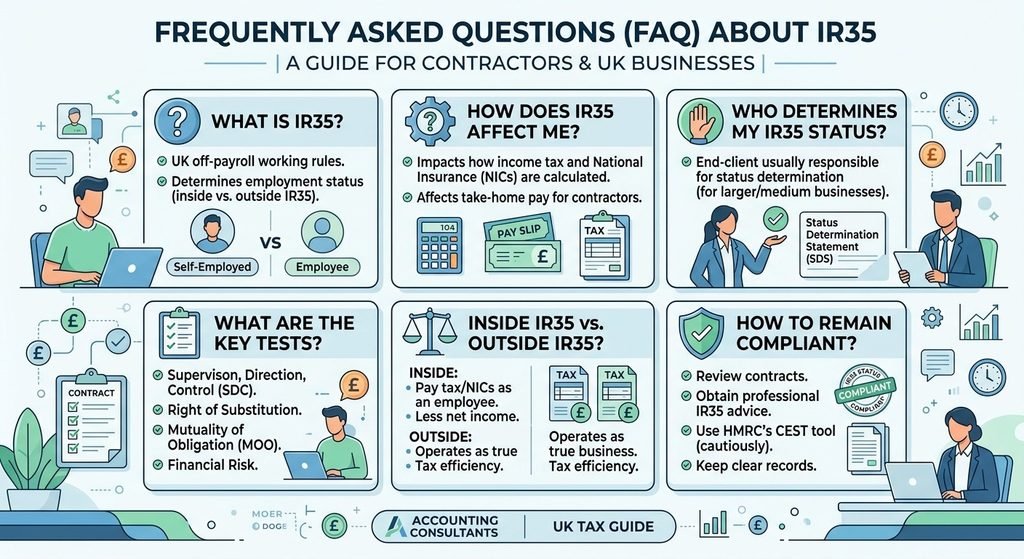
1. What is an IR35 Assessment?
An IR35 Assessment is a review used to determine whether a contractor working through a personal service company should be treated as inside or outside IR35 for tax purposes.
It considers factors such as control, substitution, financial risk, and the nature of the working relationship.
2. Who needs an IR35 Assessment?
Businesses engaging contractors through limited companies or other intermediaries should consider carrying out IR35 Assessments, particularly medium and large organisations affected by the off-payroll working rules.
3. Is IR35 only for contractors?
No. IR35 affects both contractors and organisations that engage them.
Businesses may have responsibilities for assessing contractor status, issuing determinations, and managing compliance.
4. What is the difference between inside IR35 and outside IR35?
Inside IR35 means the working relationship is considered similar to employment for tax purposes.
Outside IR35 means the contractor is considered genuinely self-employed and responsible for managing their own tax affairs.
5. Can HMRC challenge an IR35 decision?
Yes. HMRC can review employment status decisions and consider whether reasonable care was taken when making the determination.
6. How long does an IR35 Assessment take?
The timeframe depends on the complexity of the engagement.
A straightforward contractor review may be completed relatively quickly, while complex arrangements involving multiple contractors may require a more detailed analysis.
7. Do I need professional advice for IR35 compliance?
Professional advice can be useful where contractor arrangements are complex or where businesses want stronger evidence supporting their employment status decisions.
8. Can Bloom Financials help with IR35 Assessments?
Yes. Bloom Financials helps UK businesses review contractor arrangements, assess compliance risks, and develop practical processes for managing IR35 requirements.
Summary: Understanding IR35 Assessments
IR35 Assessments help businesses determine whether contractor engagements should be treated as genuine self-employment or employment-like arrangements for tax purposes.
The key points businesses should remember are:
- IR35 applies to contractors working through intermediaries such as personal service companies.
- Employment status depends on the real working relationship, not only the contract wording.
- Businesses responsible for determining status should provide an Employment Status Determination Statement.
- Reasonable care and proper documentation are essential.
- Regular reviews are important when working arrangements change.
For UK businesses, effective IR35 compliance is about understanding the relationship with contractors, managing tax risks, and maintaining clear evidence behind decisions.
Bloom Financials helps businesses navigate complex UK accounting, taxation, and compliance requirements with practical professional advice.