
You look at your diary in early September and there it is: “MTD quarterly update — 7 August.” The date passed weeks ago. Nothing was submitted.
The obvious question is whether you have just earned yourself a £200 HMRC penalty.
If this is a 2026/27 Making Tax Digital for Income Tax quarterly update, the answer is no. HMRC says it will not apply penalty points for late quarterly updates during this first mandatory tax year. But the update has not disappeared. You still need to catch up, and the outstanding quarterly updates must be submitted before you can submit your 2026/27 MTD tax return.
So a missed MTD quarterly update in 2026 is better thought of as an outstanding compliance job, rather than an automatic £200 fine.
The important bit is dealing with it before one missed deadline turns into months of unfinished bookkeeping.
Missed an MTD quarterly update? Here’s the immediate answer
If you missed the 7 August 2026 deadline, HMRC’s current instruction is to send the first quarterly update as soon as possible. There are no penalty points for late quarterly updates during 2026/27, but you still need to keep the required digital records and submit the missing information.
Your practical priorities are:
- confirm that MTD for Income Tax actually applies to you;
- check that you are signed up, or whether HMRC has now signed you up;
- make sure compatible software is authorised and set to the correct accounting period;
- bring the required digital records up to date;
- correct obvious bookkeeping errors;
- send the outstanding quarterly update; and
- organise the records for the next deadline, 7 November 2026.
HMRC’s own post-deadline guidance gives essentially this sequence: sign up where necessary, authorise the software, create the required digital records and send the first update.
First, check whether you were actually required to submit one
Not every person completing a Self Assessment tax return entered MTD for Income Tax on 6 April 2026.
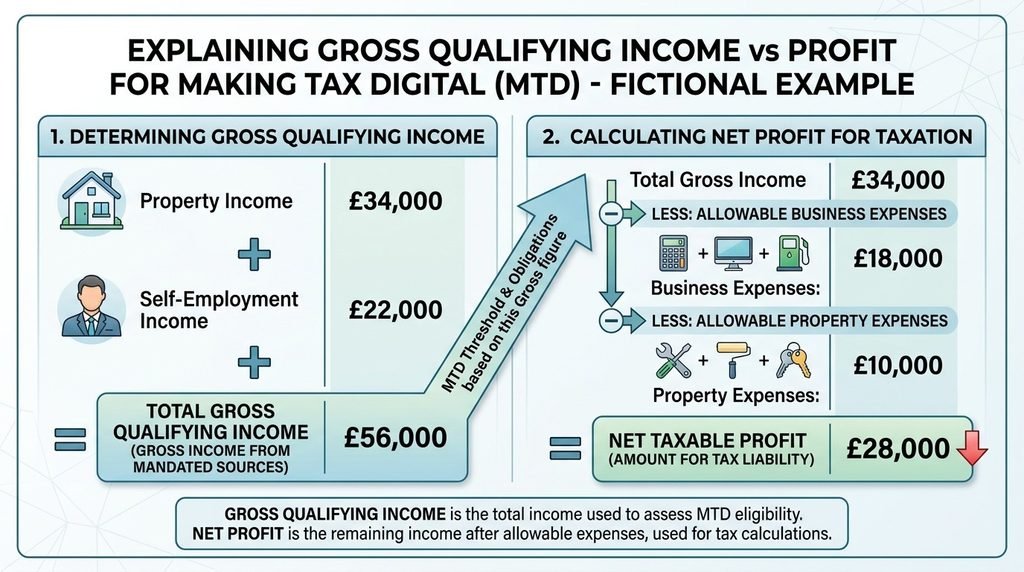
For the first mandatory phase, HMRC looks at qualifying income, which broadly means the total gross income from self-employment and property before expenses, based on the relevant earlier Self Assessment return.
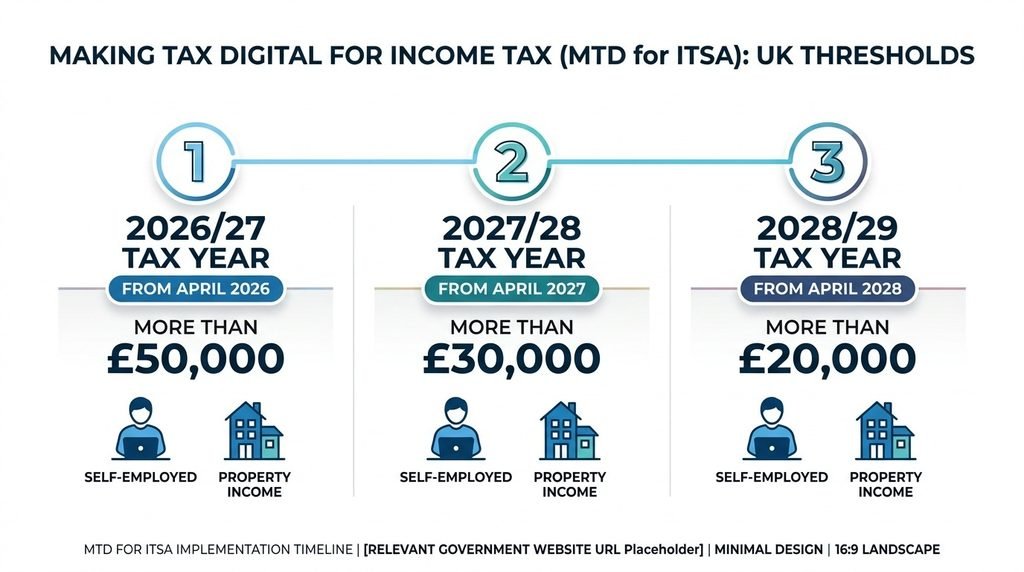
HMRC’s current staged timetable is:
| MTD tax year / stage | Relevant qualifying income threshold | MTD start date | Quarterly late-submission position |
| 2026/27 | More than £50,000 in 2024/25 | 6 April 2026 | No penalty points for late quarterly updates in 2026/27 |
| 2027/28 | More than £30,000 in 2025/26 | 6 April 2027 | Quarterly penalty-point rules apply |
| 2028/29 | More than £20,000 in 2026/27 | 6 April 2028 | Quarterly penalty-point rules apply under current rules |
The thresholds are “more than”, not “£50,000 or more”, “£30,000 or more” or “£20,000 or more”.
Qualifying income means gross income, not profit
This catches people out.
Suppose, purely as an illustration, a landlord also has a sole-trade business and their 2024/25 figures show:
- gross property income: £34,000
- gross self-employment income: £22,000
- combined qualifying income: £56,000
They are above the first £50,000 MTD threshold even if their eventual taxable profit, after allowable expenses and other adjustments, is much lower.
Employment income taxed through PAYE does not form part of the MTD qualifying-income calculation. HMRC also excludes, among other things, an individual partner’s share of partnership profits, dividends and pension income from qualifying income.
If you are uncertain about the threshold itself rather than the missed deadline, Bloom Financials’ existing MTD readiness guide covers the preparation and eligibility side in more detail.
An exemption can also alter the position. HMRC has both automatic exemptions and exemptions that have to be applied for, including circumstances involving digital exclusion. If you are exempt from MTD, you still normally continue reporting through Self Assessment.
What happens if you missed the 7 August 2026 MTD deadline?
The 7 August 2026 deadline has passed. For most taxpayers using standard update periods, it related to records from 6 April to 5 July 2026.
The good news is unusually straightforward:
HMRC will not apply a penalty point for a late quarterly update during the 2026/27 tax year.
That means missing 7 August 2026 does not automatically give you one penalty point and it does not automatically produce a £200 penalty.
That doesn’t mean you should leave it.
HMRC says taxpayers who missed the first deadline should submit the update as soon as possible, and outstanding quarterly updates must be sent before the relevant MTD tax return can be submitted.
The 2026/27 deadlines
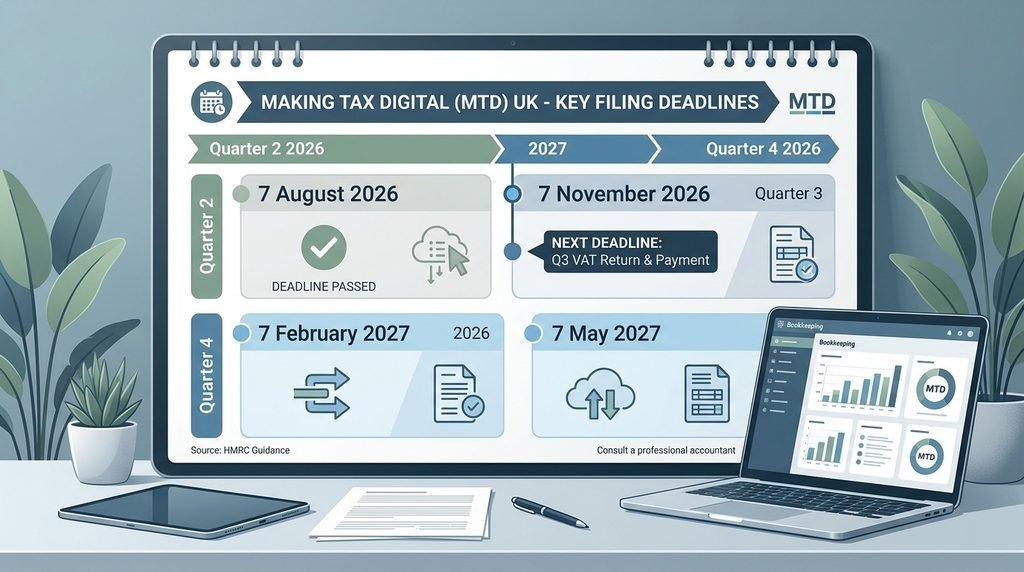
For standard update periods, the current schedule is:
| Quarterly update | Period covered cumulatively | Deadline | Position as at 5 September 2026 |
| First | 6 April–5 July 2026 | 7 August 2026 | Passed — submit as soon as possible if outstanding |
| Second | 6 April–5 October 2026 | 7 November 2026 | Next deadline |
| Third | 6 April 2026–5 January 2027 | 7 February 2027 | Future deadline |
| Fourth | 6 April 2026–5 April 2027 | 7 May 2027 | Future deadline |
If your accounting period runs from 1 April to 31 March, you may instead use calendar update periods: 1 April–30 June, 1 April–30 September, 1 April–31 December and 1 April–31 March. The submission deadlines remain 7 August, 7 November, 7 February and 7 May. The update-period choice needs to be handled correctly in your software.
Here’s where it gets interesting: the updates are cumulative
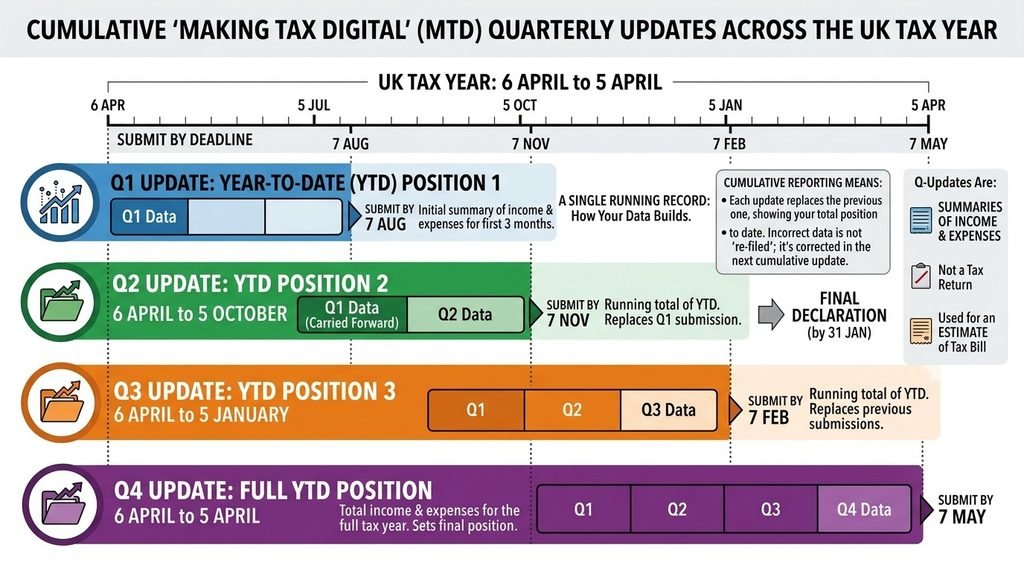
An MTD quarterly update is not simply a standalone return covering the previous three months.
HMRC says each update runs from the start of the tax year to the end of that update period. So the second standard update, for example, contains cumulative totals from 6 April to 5 October.
That matters when you are catching up.
If you discover in September that an April expense was miscoded, you correct the underlying digital record. The corrected figure can then feed into the next cumulative update; HMRC says this structure means you do not normally have to resend earlier updates merely because records have subsequently been corrected.
That cumulative mechanism is one reason it is better to fix the bookkeeping itself than simply try to “get a number filed”.
Will HMRC fine you for a late MTD quarterly update?
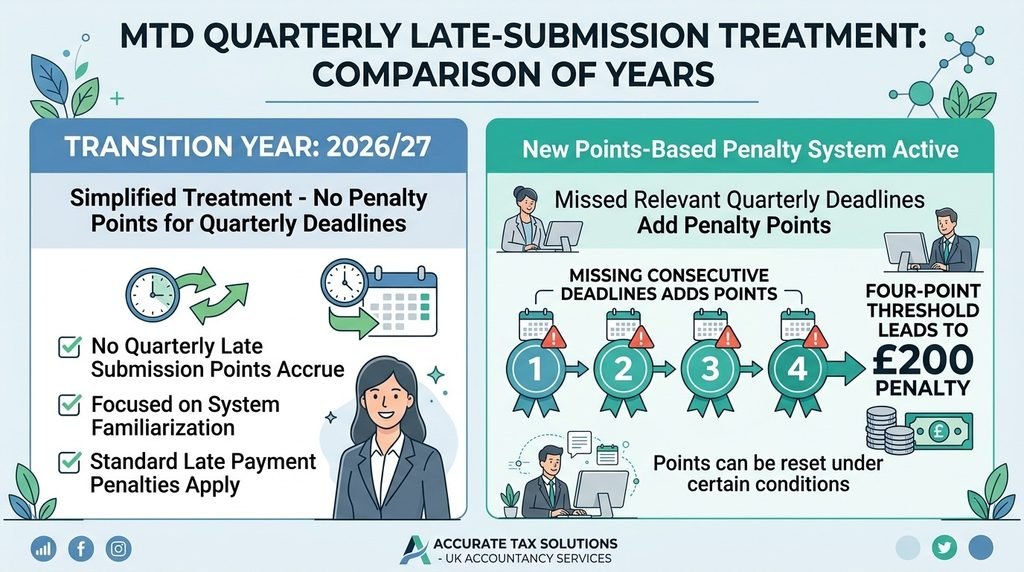
In 2026/27: not for the late quarterly update itself
For the 2026/27 transition year, HMRC says there are no penalties for missing a quarterly-update deadline.
However, different obligations remain separate. Penalty points can still apply to a late tax return, and late tax payments have their own penalty and interest rules.
So “no quarterly penalty point” does not mean “nothing under MTD has a deadline this year”.
From 2027/28: the position changes
For tax years after 2026/27, a missed relevant quarterly-update deadline ordinarily produces one late-submission penalty point.
The threshold for quarterly MTD obligations is four points. When you reach four points, HMRC charges a £200 penalty. If you then miss another submission deadline while still at the threshold, another £200 penalty can be charged.
HMRC also says you can receive only one point per deadline, even where you have more than one business and therefore more than one quarterly update due on the same date.
That distinction is important: one late quarterly update after 2026/27 does not automatically mean a £200 bill.
What should you do after missing an MTD quarterly update?
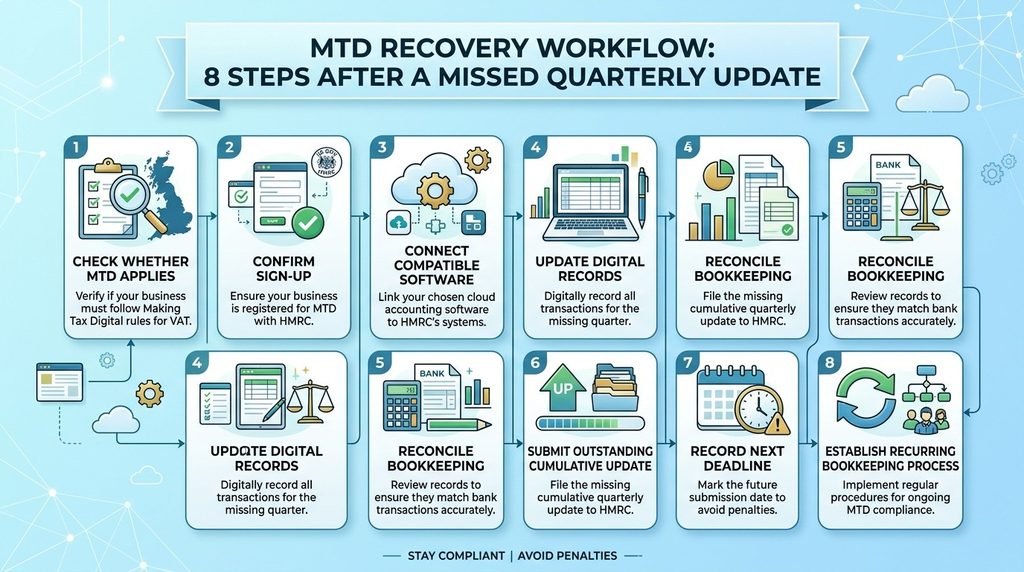
A sensible recovery process is less about pressing “submit” immediately and more about making sure the machinery underneath the submission works.
1. Confirm that MTD applies to you
Check the qualifying-income year and threshold, your income sources and whether an exemption or changed circumstance affects your position.
Do not rely purely on your taxable profit figure or assume that a PAYE salary pushes you over the threshold. The MTD qualifying-income test is different.
2. Check your MTD sign-up position
If you were required to use MTD from April 2026 but did not sign up, deal with the registration position now.
As of September 2026, HMRC has started a staged process of automatically signing up people it believes should already be using MTD for 2026/27. If HMRC has not yet signed you up, its current guidance says you can still sign yourself up or ask your agent to do it.
Bloom Financials has also published separate guidance on HMRC’s automatic MTD sign-up process.
3. Make sure your compatible software is connected correctly
MTD submissions have to be made through compatible commercial software.
HMRC says the software, or a combination of digitally linked products, needs to support digital records, quarterly updates and the eventual tax return. Spreadsheet users may be able to retain spreadsheets where suitable bridging software connects those records to the MTD process.
Before submitting, check that the software is authorised to communicate with HMRC and that the correct accounting/update period has been selected.
Bloom Financials’ cloud accounting and digital services include cloud accounting, digital tax services and training/support around accounting software such as Xero, QuickBooks and Sage.
4. Catch up the digital records
Signing up late does not allow you simply to start the books from today.
HMRC says that if you sign up part-way through the tax year, you need to catch up your digital record keeping from the start of the relevant tax year.
In practical terms, that may mean going back through business bank transactions, property records, invoices, receipts and other source information to build the missing period.
5. Reconcile and correct obvious bookkeeping errors
Quarterly updates are summaries rather than tax returns, and HMRC says you do not need to make final accounting or tax adjustments before sending one.
But that is not permission to knowingly submit avoidably poor records.
Check obvious issues such as duplicated sales, uncategorised expenditure, personal transfers posted as business income, missing invoices and transactions recorded against the wrong property or sole-trade activity.
6. Send the outstanding update
Once the underlying digital records and software connection are in workable order, send the outstanding quarterly update.
HMRC’s August 2026 post-deadline instruction is explicit: taxpayers and agents who missed the first deadline should send the first quarterly update as soon as possible.
7. Put 7 November 2026 into the operating process, not merely the diary
A calendar reminder helps, but it does not reconcile a bank account.
Decide who is responsible for recording transactions, clearing queries, reviewing the bookkeeping and making the submission before the next deadline. The second update is cumulative to 5 October for standard periods, so unresolved errors from the first part of the year can continue into the next reporting cycle.
What if you haven’t signed up for MTD yet?
If you were required to use MTD from 6 April 2026 and never signed up, the correct response is not to wait indefinitely for HMRC to contact you.
HMRC’s guidance, updated on 24 August 2026, says that from September it will start automatically signing up people who need to use MTD for 2026/27 but have not signed themselves up. The process is staged. If HMRC has not signed you up, you can still sign yourself up or have an agent do so.
There is a practical advantage in checking the position yourself. HMRC says an automatic sign-up relies on information it already holds, which may not reflect changes since your previous tax return.
If a trade has ceased, property circumstances have changed or HMRC’s information is otherwise wrong, the correct next step may therefore involve updating the MTD record or contacting HMRC rather than blindly filing against outdated details.
Do you need to call HMRC because the update is late?
Usually, being late by itself does not mean you must telephone HMRC before submitting the update.
HMRC’s current post-deadline guidance tells taxpayers and agents to catch up: check the sign-up, authorise compatible software, create the required digital records and send the update as soon as possible. It does not state that a phone call is a prerequisite to filing a late 2026/27 quarterly update.
You may need HMRC involvement where there is a separate issue — for example, an exemption application, incorrect HMRC-held information, ceased income sources or another account problem that cannot simply be corrected through the normal MTD process.
What if your books aren’t ready?

This is often the real problem behind a missed deadline.
Perhaps your bank feed is connected, but 40 transactions are still awaiting review. Your letting income sits in a spreadsheet. A personal transfer has been recorded as sales. Two invoices were imported twice. Or the expenses for a second property have been mixed into your sole-trade records.
Submitting an update does not resolve those bookkeeping problems.
MTD compatible software builds quarterly totals from the digital records underneath it. HMRC also makes clear that you or your agent remain responsible for checking records before information is sent. Digital records should therefore be corrected when errors are identified.
A useful catch-up exercise commonly includes:
- reconciling bank and card accounts;
- identifying uncategorised or duplicated transactions;
- separating personal transfers from genuine business receipts;
- locating missing sales invoices or property-income records;
- making sure different businesses or property activities have been recorded appropriately;
- correcting transaction dates and categories; and
- checking that spreadsheet and bridging-software links work properly where more than one product is involved.
This is where accounting and bookkeeping support can be more useful than treating MTD as a one-off filing task. Bloom Financials’ published accounting services include bookkeeping and cloud accountancy design and tax implementation.
Can you correct figures after an MTD quarterly update?
Yes. HMRC’s system is designed so corrected digital records can feed into later cumulative updates.
Suppose you submitted the first update and later discover that a May expense was entered incorrectly. You should correct the digital record when you become aware of the error.
Because the next quarterly update contains cumulative totals from the start of the tax year, the corrected figures can be reflected in that later update without normally requiring you to resend the earlier quarterly update.
There is an end-of-year catch: if a correction is made after the fourth quarterly update, HMRC guidance says the fourth update may need to be resent so the corrected record is included before the final tax-return process is completed.
This is another reason quarterly bookkeeping should be treated as a continuous record rather than four unrelated mini tax returns.
Does missing an MTD quarterly update affect your tax return?
It can affect the workflow, because HMRC requires the quarterly updates to be sent before the relevant MTD tax return can be submitted.
The MTD tax return remains an annual return. For the 2026/27 tax year, it must be submitted by 31 January 2028.
There is also an easy first-year trap to overlook. If you entered MTD on 6 April 2026, your 2025/26 Self Assessment tax return is still dealt with under the previous system and is due by 31 January 2027. HMRC explicitly says the pre-MTD year continues to be submitted in the normal way.
So somebody catching up a missed August MTD update may have two different workstreams:
- the new 2026/27 MTD records and quarterly updates; and
- their separate 2025/26 Self Assessment return.
Keeping the two coordinated is more useful than treating MTD as a replacement for the annual tax-return job.
Bloom Financials lists Personal Self Assessment and tax compliance support among its current taxation services.
Does missing an update mean you’ve missed a tax payment?
No. Sending an MTD quarterly update does not itself mean paying Income Tax four times a year.
HMRC describes the quarterly submissions as summaries, not tax returns, and its current MTD guidance says taxpayers continue to submit one tax return each tax year and pay their tax bill under the normal timetable.
The quarterly process can generate an estimated tax figure, which may be useful for budgeting, but that estimate does not turn the quarterly-update deadline into a quarterly Income Tax payment date.
A late tax payment is a separate matter and can attract its own penalties and interest.
What changes after 2026/27?
The penalty soft landing for quarterly updates is specifically a 2026/27 provision.
From 2027/28, under HMRC’s current rules, missing a relevant quarterly-update deadline gives you one point. The usual quarterly threshold is four points. Reach four, and a £200 penalty becomes payable; further missed submission deadlines while you remain at the threshold can produce further £200 penalties.
A simple worked example
Imagine a taxpayer is required to use MTD in 2027/28 and, without any other penalty-point complications, misses all four standard quarterly deadlines:
- 7 August 2027: first point. No £200 penalty yet.
- 7 November 2027: second point.
- 7 February 2028: third point.
- 7 May 2028: fourth point. The four-point threshold is reached and a £200 penalty applies.
If another relevant submission deadline is then missed while the taxpayer remains at the threshold, HMRC can impose another £200 penalty.
HMRC says points below the threshold will normally expire 24 months after the missed deadline. Once the threshold has been reached, clearing the points requires a period of compliance as well as bringing specified outstanding submissions up to date.
The distinction matters because “MTD has £200 penalties” is true but incomplete. The first missed quarterly deadline after the transitional year does not itself normally trigger £200.
A practical example: catching up after a missed update
Consider Aisha, a fictional example.
She has a rental property and also works as a self-employed consultant. Her 2024/25 Self Assessment figures show:
- gross property income: £34,000
- gross consulting income: £22,000
- combined MTD qualifying income: £56,000
Even if her combined profit after expenses were, say, £30,000, the MTD test starts from the £56,000 gross qualifying income, so she falls within the cohort required to use MTD from 6 April 2026.
At the beginning of September 2026, she realises that she missed the 7 August update.
Her bookkeeping is also incomplete. The rental records are in a spreadsheet, her consulting bank feed contains several uncategorised transactions, and a £2,000 transfer from her personal savings account has been wrongly labelled as business income.
The sensible recovery sequence is not to leave those issues untouched and send whatever figures happen to appear on screen.
Instead, she:
- confirms that the £56,000 figure placed her above the 2026/27 threshold;
- checks whether she is already signed up or has been included in HMRC’s September automatic-sign-up process;
- confirms that her software is compatible and authorised;
- brings the required digital records up to date from the relevant start date;
- reconciles her consulting transactions and corrects the £2,000 personal transfer;
- checks that the property records are properly connected to the MTD process;
- submits the outstanding first quarterly update as soon as possible; and
- continues the bookkeeping through 5 October so the cumulative second update can be sent by 7 November 2026.
She also keeps her 2025/26 Self Assessment return, due 31 January 2027, on a separate task list from her first 2026/27 MTD tax return, due 31 January 2028.
No fictional £200 “August fine” needs to be added to this example because, under current HMRC rules, there is no penalty point for the late 2026/27 quarterly update.
How to stop the next MTD deadline becoming another catch-up exercise
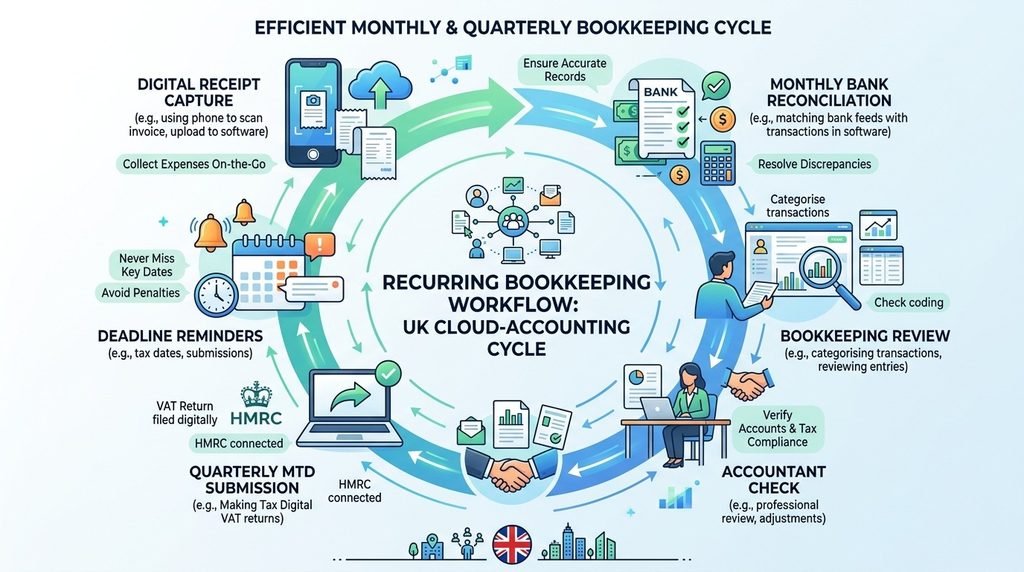
MTD becomes much easier when quarterly submission is the final step in a routine bookkeeping process rather than the point at which bookkeeping begins.
A practical system might include:
- monthly bank and card reconciliations, rather than three months of transactions being reviewed at once;
- regular digital capture of sales invoices, receipts and property records;
- an internal bookkeeping cut-off before the HMRC submission deadline;
- a clear split of responsibilities between you, your bookkeeper and your accountant;
- a short quarterly review of unusual or uncategorised transactions;
- checking software connections and authorisations before the deadline week; and
- reminders for both the quarterly MTD cycle and the separate annual tax-return process.
If you use several accounts, have both property and self-employment income, or maintain part of your records in spreadsheets, the process should also make clear where the authoritative record sits and how information moves digitally between systems.
The aim is not simply “never miss a date”. It is to have records that are already close to ready when the date arrives.
When an accountant can help
Missing one quarterly update does not automatically mean you need to hand your entire finance function to an accountant.
Professional help becomes more useful when the reason for the missed deadline is harder to identify or repair — for example, where you are unsure whether MTD applied in the first place, your software has not been connected properly, several months of records need reconstructing, or your MTD and annual Self Assessment work are starting to overlap.
Based on its currently published services, Bloom Financials can assist with areas including:
- bookkeeping and accounting records;
- cloud-accountancy design and digital accounting processes;
- digital tax services;
- accounting-software support and training;
- Personal Self Assessment;
- tax compliance; and
- coordinating the accounting information needed for HMRC reporting.
If the deadline has already passed and you’re unsure whether the problem lies in your MTD status, bookkeeping, software or reporting process, Bloom Financials can help establish what needs attention and organise a more workable process before the next deadline.
You can contact Bloom Financials to discuss your circumstances.
What happens if I miss an MTD quarterly update?
For the 2026/27 tax year, HMRC will not apply penalty points for late MTD quarterly updates. You should nevertheless send the outstanding update as soon as possible and continue keeping the required digital records. HMRC requires the quarterly updates to be submitted before you can submit the relevant MTD tax return.
Is there a £200 fine for missing the August 2026 MTD deadline?
No. Missing the 7 August 2026 quarterly-update deadline does not automatically produce a £200 penalty. HMRC says there are no quarterly-update penalty points during 2026/27. From later tax years the points system applies, with a £200 penalty once the usual four-point quarterly threshold is reached.
Can I submit an MTD quarterly update after the deadline?
Yes. HMRC’s August 2026 guidance specifically tells taxpayers and agents who missed the first deadline to send the quarterly update as soon as possible. You may first need to catch up digital records, complete your MTD sign-up or correct your software connection.
Do I need to contact HMRC if my quarterly update is late?
Not simply because the 2026/27 update is late. HMRC’s current guidance directs taxpayers to catch up and submit rather than requiring a phone call first. You may need to contact HMRC for a separate issue, such as correcting information HMRC holds, dealing with a ceased income source or addressing an exemption or account problem.
What if I haven’t registered for MTD?
If you were required to use MTD from April 2026, check your position now. From September 2026 HMRC is beginning to sign up unregistered people it believes should already be using the service. If HMRC has not signed you up, its current guidance says you can still register yourself or ask an agent to do it.
Does MTD mean I have to pay Income Tax every quarter?
No. Quarterly updates are reporting submissions, not quarterly Income Tax returns or payment demands. HMRC says you continue to submit one annual tax return and pay tax under the existing payment timetable. Quarterly submissions can provide estimated tax figures, but they do not create four new Income Tax payment dates.
Can my accountant send my MTD quarterly updates?
Yes, provided the appropriate agent authorisation and software arrangements are in place. HMRC’s agent guidance expressly contemplates accountants and bookkeepers acting for MTD clients, including signing them up where authorised, creating or working with digital records and submitting quarterly information.
What happens if my bookkeeping isn’t complete?
Bring the records up to date before treating submission as the only problem. HMRC does not require final tax or accounting adjustments for each quarterly update, but the update is built from your digital income and expense records. Correct missing, duplicated or miscoded transactions and make sure your software or digital links work properly.
Can I correct an MTD quarterly update?
You can correct the underlying digital records. Because MTD quarterly updates are cumulative, the corrected totals can generally be reflected in the next update without resending earlier quarters. If a correction is made after the fourth update, HMRC guidance indicates that the fourth update may need to be resent before the annual tax-return process is finalised.
Will one missed MTD deadline give me a penalty point?
For an MTD quarterly-update deadline in 2026/27, no. HMRC has suspended quarterly penalty points for this first mandatory tax year. For tax years after 2026/27, a missed relevant quarterly deadline ordinarily produces one point. The normal quarterly threshold is four points, at which point the £200 penalty applies.
Bottom line
A missed MTD quarterly update in 2026/27 is not the automatic £200 penalty some taxpayers understandably fear.
HMRC has explicitly switched off penalty points for late quarterly updates during this first mandatory tax year. But the reporting obligation still exists, and doing nothing can store up a larger practical problem because the outstanding updates must be dealt with before the relevant annual MTD tax return can be submitted.
So check whether MTD applies to you, fix your registration and software position if necessary, bring the digital records up to date and submit the missing update as soon as reasonably possible.
Then turn your attention to 7 November 2026.
The first missed deadline may not carry a quarterly penalty point. The better outcome is making sure it does not become the beginning of a permanent catch-up cycle.
General information only: This article provides general information based on HMRC guidance available on 5 September 2026. MTD obligations can depend on individual circumstances, so check current GOV.UK guidance or obtain professional advice for your position.