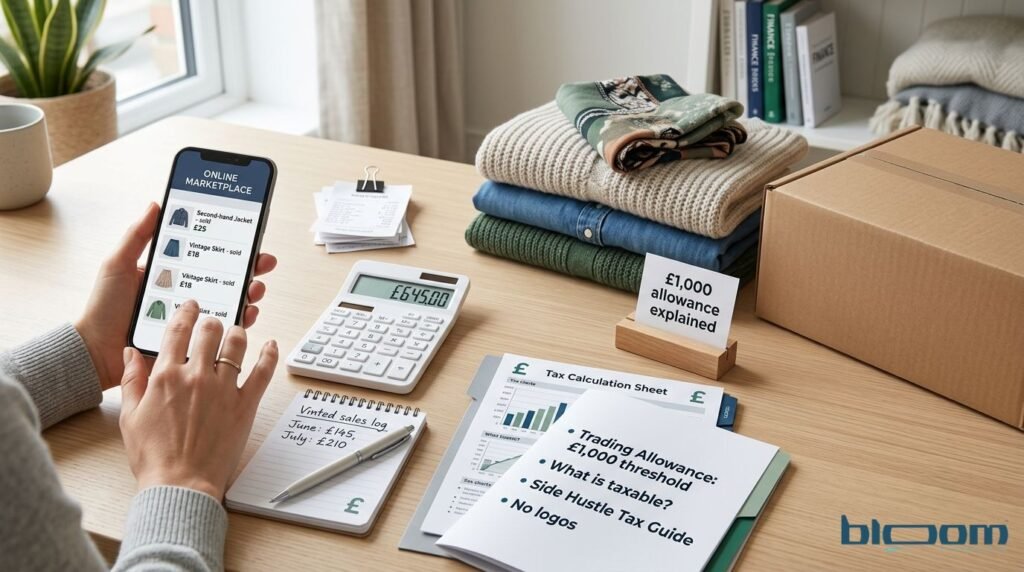
If you’ve been clearing out your wardrobe, selling children’s clothes, or turning charity shop finds into extra cash, you’ve probably wondered: “Will HMRC tax me for selling on Vinted?” It’s a fair question, especially now online platforms are sharing more seller information with HMRC.
The good news is that not every Vinted seller owes tax. For many casual sellers, selling unwanted personal items does not create a tax bill. But if your Vinted activity looks more like a side hustle or small business, the UK Trading Allowance becomes very important.
In simple terms, the tax position depends on what you’re selling, why you’re selling it, how regularly you sell, and whether you’re making money from trading rather than simply disposing of personal possessions.
Here’s where it gets important: the £1,000 UK Trading Allowance can be helpful, but it is often misunderstood. It is not a blanket “you can sell £1,000 of old clothes before tax” rule. It applies to gross trading income, and that distinction matters.
This guide explains how Vinted tax UK rules work, when HMRC may see your activity as trading, what the 30 items and £1,700 figures really mean, and when you may need to register for Self Assessment.
Table of Contents
ToggleQuick answer box: How much can you earn on Vinted before paying tax?
If you are simply selling your own unwanted clothes or personal possessions on Vinted, you usually will not pay tax because you are not trading. You are just selling things you already own.
If you are buying items to resell, making items to sell, or running your Vinted account with a profit motive, HMRC may treat this as trading activity. In that case, you can usually receive up to £1,000 of gross trading income in a tax year under the UK Trading Allowance before you need to tell HMRC.
The UK tax year runs from 6 April to 5 April. If your total gross trading income from Vinted and any other side hustles goes over £1,000 in the tax year, you may need to register for Self Assessment and report the income.
The key point is this: selling personal items is not the same as trading. The £1,000 allowance applies to trading income, not ordinary wardrobe clear-outs.
What is the UK Trading Allowance?
The UK Trading Allowance is a tax-free allowance of up to £1,000 per tax year for trading income. It can apply to small amounts earned from activities such as casual self-employment, selling goods, freelance work, online content income, or other side hustle income.
For Vinted sellers, the allowance becomes relevant when the activity counts as trading. Trading usually means you are selling goods or services with a commercial purpose, rather than simply selling personal items you no longer need.
The allowance is based on gross trading income. That means the total amount you receive before deducting allowable expenses.
For example, if you buy second-hand clothes for £500 and sell them on Vinted for £1,200, your gross trading income is £1,200. Your profit might be much lower after stock costs, postage and packaging, but the £1,000 threshold looks at gross income when deciding whether you need to tell HMRC.
If your gross trading income is £1,000 or less in the tax year, the allowance may mean you do not need to tell HMRC about that trading income. If your gross trading income is more than £1,000, you may need to register for Self Assessment and declare it.
You cannot normally claim the £1,000 trading allowance and deduct actual business expenses from the same income. Once you are over the threshold, you generally compare two approaches:
- Deduct the £1,000 trading allowance from your gross trading income.
- Deduct your actual allowable expenses and calculate taxable profit.
The best option depends on your numbers.
Does selling on Vinted count as taxable income?
Selling on Vinted can count as taxable income, but it does not always. HMRC looks at the nature of what you are doing.
There are two broad situations.
The first is casual disposal of personal possessions. This might include selling clothes you bought for yourself, baby clothes your child has outgrown, shoes that no longer fit, or an unwanted coat sitting in your wardrobe. In many cases, these items sell for less than you originally paid. That usually does not create taxable trading income.
The second is trading activity. This is where you buy or make items with the intention of selling them for a profit. If you regularly source stock from charity shops, car boot sales, wholesalers or online marketplaces and list it on Vinted to make money, HMRC may view you as trading.
In simple terms, HMRC is less interested in the app you use and more interested in your behaviour.
Ask yourself:
- Did I buy the item for personal use, or did I buy it to resell?
- Am I selling occasionally, or listing regularly?
- Am I trying to make a profit?
- Do I keep records of stock, margins and costs?
- Am I reinvesting money into more items to sell?
- Does my Vinted account look like a small shop?
No single answer decides everything, but the pattern matters.
When selling old clothes usually does not create a tax bill
For many casual sellers, Vinted is just a way to clear space and recover a little money.
You are unlikely to be trading if you are selling:
- clothes you bought for yourself;
- items your children have outgrown;
- unwanted gifts;
- shoes, bags or accessories you no longer use;
- household items from a clear-out;
- occasional personal possessions.
For example, a parent selling a bundle of outgrown baby clothes for £80 is usually not running a business. A student selling last year’s clothes before moving flat is usually not trading either.
Even if the total sales proceeds look quite high over the year, that does not automatically mean tax is due. Someone could sell £1,300 of personal clothes and still not be trading, particularly if the items were originally bought for personal use and sold for less than they cost.
However, keep some basic records if your sales volume is high. If HMRC ever asks, it helps to show that you were selling personal possessions rather than operating as a reseller.
When Vinted selling may count as trading
If you are buying to resell, this is where professional advice can save you stress.
Vinted selling may count as trading if you:
- buy clothes, trainers, bags or accessories specifically to resell;
- source items from charity shops, outlets, sample sales or car boot sales;
- upcycle or customise clothing with the intention of selling it;
- make handmade items to sell;
- list items regularly and in an organised way;
- price items based on margins;
- reinvest profits into more stock;
- run your Vinted activity alongside other side hustles.
A profit motive is one of the biggest indicators. If the aim is to buy low and sell high, HMRC may see that as trading.
That does not mean you need to panic. It simply means you should treat your activity properly, keep records and check whether the UK Trading Allowance applies.
How much can you earn before telling HMRC?
If your Vinted activity is trading, you usually need to look at your total gross trading income for the tax year.
The current key figure is £1,000.
If your total gross trading income from all trading activities is £1,000 or less in the tax year, the UK Trading Allowance may cover it.
If your total gross trading income is more than £1,000, you may need to tell HMRC and complete a Self Assessment tax return.
This is not just about Vinted. You must add together trading income from different side hustles. For example, Vinted reselling, dog walking, tutoring, freelance design work and selling handmade products may all count towards the same £1,000 trading allowance.
The tax year runs from 6 April to 5 April. That means you should not simply rely on Vinted’s calendar-year summaries without checking whether the sales fall into the correct UK tax year.
What happens if you earn more than £1,000?
If your gross trading income is over £1,000, you may need to register for Self Assessment and report the income to HMRC.
You do not necessarily pay tax on the full sales figure. Tax is usually based on taxable profit, not total sales.
Your taxable profit is generally:
Sales income minus allowable expenses equals taxable profit.
For a Vinted reseller, allowable expenses might include the cost of goods, postage and packaging, platform fees, payment charges, labels, storage materials, and other costs that are wholly and exclusively for the trading activity.
Alternatively, you may choose to use the £1,000 trading allowance instead of actual expenses if that gives a better result.
Here’s a simple example:
- Vinted sales from reselling: £1,800
- Stock bought from charity shops: £700
- Postage and packaging: £180
- Platform-related costs and supplies: £40
- Total expenses: £920
- Taxable profit using actual expenses: £880
In this case, claiming actual expenses may produce a lower taxable profit than deducting the £1,000 allowance from £1,800, which would leave £800. Actually, in this example the trading allowance gives a slightly better result. This is why it is worth checking the numbers before filing.
Does Vinted report your sales to HMRC?
Digital platform reporting rules mean platforms such as Vinted may collect and report certain seller information to HMRC. This is part of wider HMRC online marketplace reporting and does not mean that everyone reported automatically owes tax.
The key point is that platform reporting is about information sharing. It is not a new tax on selling unwanted clothes.
A platform report may show sales amounts and other details for a calendar year. Your tax position still depends on whether you were trading, whether you made a capital gain, and whether you need to report income for the UK tax year.
So, will HMRC know about your Vinted sales? Possibly, especially if your activity meets the platform reporting criteria. But being reported is not the same as owing tax.
What do the 30 items and £1,700 figures mean?
The 30 items and £1,700 figures are often misunderstood.
They relate to digital platform reporting rules, not directly to whether you owe tax.
Broadly, online platforms may need to report information about sellers who meet certain criteria. For sales of goods, the figures often discussed are 30 sales and around £1,700, which reflects €2,000. If you meet the reporting conditions, the platform may tell you your information has been shared with HMRC.
This does not mean you can only sell 30 items tax-free. It also does not mean tax starts automatically once your Vinted sales reach £1,700.
For tax, the more important questions are:
- Are you trading?
- Are you making a capital gain?
- Is your gross trading income over the £1,000 UK Trading Allowance?
- Do you need to register for Self Assessment?
For many casual sellers, the 30 items figure creates unnecessary worry. You could sell 35 personal wardrobe items and still not be trading. On the other hand, you could sell fewer than 30 items but still be trading if you bought them specifically to resell at a profit.
Examples of casual selling vs trading
Example 1: Selling old clothes from your wardrobe
Amelia works full-time and uses Vinted to clear out clothes she no longer wears. During the 2026 to 2027 tax year, she sells 42 items and receives £1,250.
Most items were bought for personal use over several years. She sells them for less than she originally paid. She is not buying new stock to resell.
This is likely to be casual disposal of personal possessions, not trading. The £1,000 UK Trading Allowance is not really the main issue because Amelia is not carrying on a trading activity. She should keep basic evidence, such as item descriptions and original purchase records where available, but she is unlikely to have a Vinted tax bill on these facts.
Example 2: Buying stock from charity shops and reselling on Vinted
Ravi visits charity shops every weekend and buys branded clothes to resell on Vinted. In the 2026 to 2027 tax year, his Vinted sales are £3,600. He spends £1,450 on stock, £320 on postage and packaging, and £90 on other selling supplies.
Ravi has a clear profit motive and is buying to resell. This is likely to be trading.
His gross trading income is £3,600, which is over the £1,000 UK Trading Allowance. He will likely need to register for Self Assessment and report the income.
Using actual expenses:
- Sales proceeds: £3,600
- Cost of goods: £1,450
- Postage and packaging: £320
- Other allowable expenses: £90
- Taxable profit: £1,740
That profit may be subject to Income Tax and possibly National Insurance depending on Ravi’s wider income and profit levels.
Example 3: More than £1,000 from multiple side hustles
Sophie sells handmade accessories on Vinted and occasionally does freelance social media work. In the tax year, she receives:
- £650 from handmade accessories sold on Vinted;
- £580 from freelance social media work;
- £220 from selling a few personal clothes she no longer wears.
The personal clothes may not be trading income. But her handmade accessories and freelance work are trading income. Together, those trading receipts are £1,230.
Because the UK Trading Allowance is a single allowance across trading income, Sophie cannot claim £1,000 for each side hustle. Her gross trading income is over £1,000, so she may need to tell HMRC and consider Self Assessment.
How to calculate profit, not just sales
One of the most common mistakes in selling online tax UK discussions is confusing sales with profit.
Sales proceeds are the amounts you receive from buyers. Profit is what is left after allowable expenses.
For a Vinted trader, a basic profit calculation might look like this:
Gross sales income
minus cost of goods
minus postage and packaging
minus platform fees or selling costs
minus other allowable business expenses
equals taxable profit
If you are using the trading allowance instead of actual expenses, the calculation is different:
Gross trading income
minus £1,000 trading allowance
equals taxable trading income
You cannot usually use both methods for the same income. An accountant can help you decide which approach gives the best and most accurate result.
What expenses can Vinted sellers potentially claim?
If your Vinted selling counts as trading and you claim actual expenses, you may be able to deduct costs that are wholly and exclusively for the business.
Potential allowable expenses may include:
- cost of goods bought for resale;
- postage and packaging;
- parcel bags, labels and tape;
- platform fees or payment processing charges;
- mileage or travel costs for sourcing stock, where properly calculated;
- a reasonable proportion of home office or storage costs, if relevant;
- accounting software;
- bookkeeping support;
- accountancy fees for your Self Assessment tax return.
The cost of your own personal clothes is different. If you bought an item for personal use years ago and later sold it during a clear-out, you are not usually calculating trading profit in the same way.
Good record keeping is essential. Keep receipts, screenshots, sales summaries, bank records and notes showing whether items were personal possessions or stock bought for resale.
Do you need to register for Self Assessment?
You may need to register for Self Assessment if you are trading and your gross trading income is more than £1,000 in the tax year.
For the 2025 to 2026 tax year, which ran from 6 April 2025 to 5 April 2026, the deadline to tell HMRC you need to complete a return is 5 October 2026. The online tax return and payment deadline is 31 January 2027.
For the current 2026 to 2027 tax year, which runs from 6 April 2026 to 5 April 2027, the equivalent registration deadline would usually be 5 October 2027, with the online filing and payment deadline usually 31 January 2028.
Income Tax depends on your total taxable income, not just Vinted profit. The standard Personal Allowance for 2026 to 2027 is £12,570, although personal circumstances can change how allowances apply.
National Insurance may also be relevant for self-employed traders. For 2026 to 2027, Class 4 National Insurance applies where self-employed profits are above the relevant threshold. Small side hustles may not reach that level, but it is still worth checking if your profits are growing.
What records should Vinted sellers keep?
If you only sell personal items occasionally, you do not need a full accounting system. But if you sell a lot, keep enough evidence to show what the sales relate to.
If you are trading, keep proper records from the start. Do not wait until January.
Useful records include:
- Vinted sales exports or screenshots;
- dates of sale;
- sale price and buyer payments;
- cost of goods bought for resale;
- receipts from charity shops, wholesalers or suppliers;
- postage and courier receipts;
- packaging costs;
- platform fees;
- bank statements;
- mileage or travel logs, where relevant;
- notes separating personal clear-out items from stock.
A simple spreadsheet can work for a small side hustle, but as the activity grows, bookkeeping software may save time and reduce mistakes.
Common mistakes Vinted sellers make
Mistake 1: Thinking the 30-item rule is a tax rule
The 30-item figure is linked to digital platform reporting. It is not the point at which tax automatically starts.
Mistake 2: Ignoring other side hustle income
The UK Trading Allowance is not £1,000 per platform or per side hustle. You need to add together gross trading income from relevant activities.
Mistake 3: Looking only at Vinted summaries
Some platform reports are based on the calendar year. UK tax returns use the tax year from 6 April to 5 April.
Mistake 4: Not separating personal items from stock
Mixing personal wardrobe clear-outs with bought-for-resale stock makes your records messy. Keep a clear note of what is personal and what is trading stock.
Mistake 5: Assuming no tax is due because profit is small
If your gross trading income is over £1,000, you may still need to tell HMRC even if your profit is modest.
Mistake 6: Claiming expenses without receipts
Allowable expenses need evidence. Keep receipts and records as you go.
Short answers for AEO, GEO and AI search
Do I pay tax if I sell my own clothes on Vinted?
Usually not, if you are selling your own unwanted clothes and not buying items to resell. This is normally a casual disposal of personal possessions rather than trading.
Does the £1,000 UK Trading Allowance apply to Vinted?
Yes, it can apply if your Vinted activity counts as trading. It does not usually matter for ordinary personal wardrobe clear-outs because those may not be trading income in the first place.
Will HMRC know about my Vinted sales?
Vinted and other digital platforms may report seller information to HMRC where reporting conditions are met. This does not automatically mean you owe tax.
Is the £1,000 allowance based on sales or profit?
The £1,000 UK Trading Allowance threshold is based on gross trading income, not profit. If you go over it, your taxable profit is then worked out using either the trading allowance or actual allowable expenses.
Do I need an accountant for Vinted income?
You may not need an accountant for a simple wardrobe clear-out. But if you are buying to resell, have crossed the £1,000 UK Trading Allowance, earn from multiple side hustles, or are unsure whether you are trading, professional advice can help you avoid mistakes.
How Bloom Financials can help
Vinted tax can feel confusing because the answer is rarely just one number. A casual seller clearing out old clothes is in a very different position from someone sourcing stock every week and reselling for profit.
Bloom Financials helps UK individuals, sole traders and small business owners understand their tax position clearly. We can help you work out whether your Vinted activity is casual selling or trading, whether the UK Trading Allowance applies, and whether you need to register for Self Assessment.
We can also support you with:
- Self Assessment tax returns;
- bookkeeping for online sellers;
- sole trader accounts;
- side hustle tax planning;
- allowable expense reviews;
- HMRC registration;
- small business accounting;
- practical record-keeping systems.
This is where professional advice can save you stress. It is much easier to set things up properly early than to untangle a year’s worth of mixed personal and trading sales later.
FAQ section
1. Do I pay tax on Vinted sales in the UK?
You may pay tax on Vinted sales if your activity counts as trading or if you make a taxable capital gain. If you are simply selling your own unwanted personal items, you usually will not pay tax.
2. What is the UK Trading Allowance for Vinted sellers?
The UK Trading Allowance allows up to £1,000 of gross trading income per tax year to be covered tax-free. It can apply to Vinted if your selling activity counts as trading.
3. Is the £1,000 UK Trading Allowance per side hustle?
No. It is a single £1,000 allowance for your total gross trading income in the tax year. If you have multiple side hustles, you must add the relevant trading income together.
4. Do I need to register for Self Assessment if I sell on Vinted?
You may need to register if you are trading and your gross trading income is over £1,000 in the tax year. If you only sell personal possessions, you may not need to register.
5. Does Vinted report to HMRC?
Digital platforms may report seller information to HMRC where reporting conditions are met. Being reported does not automatically mean you owe tax.
6. What are the 30 items and £1,700 Vinted figures?
These figures relate to digital platform reporting rules. They are not automatic tax thresholds. Tax depends on whether you are trading, making a capital gain, and whether your taxable income needs to be reported.
7. Can I claim postage and packaging as expenses?
If your Vinted activity is trading and you claim actual expenses, postage and packaging used for the business may be allowable. You should keep receipts and records.
8. What happens if I forgot to declare Vinted income?
If you think you should have reported trading income, speak to an accountant as soon as possible. The right action depends on the tax year, the amount involved, and whether tax is due.
Short disclaimer
This article provides general guidance only and is not personal tax advice. Tax treatment depends on your own circumstances, income, records and trading activity. Speak to Bloom Financials or a qualified accountant before making decisions about Self Assessment, allowable expenses, HMRC reporting or your Vinted income.
Conclusion
So, how much can you earn on Vinted before paying tax?
If you are selling your own unwanted clothes, you may not be trading at all, and there may be no tax to pay. If you are buying or making items to sell for profit, your Vinted income may count as trading income. In that case, the £1,000 UK Trading Allowance is the key starting point.
Once your gross trading income from Vinted and other side hustles goes over £1,000 in a tax year, you may need to tell HMRC and file a Self Assessment tax return. You may then pay tax on your taxable profit, not necessarily your total sales.
The key point is to look at the facts: what you sell, why you sell it, how often you sell, and whether there is a profit motive.
If you are unsure whether you are casually selling or trading, or you have crossed the £1,000 UK Trading Allowance, Bloom Financials can help you get clear, practical advice and file your Self Assessment tax return correctly.