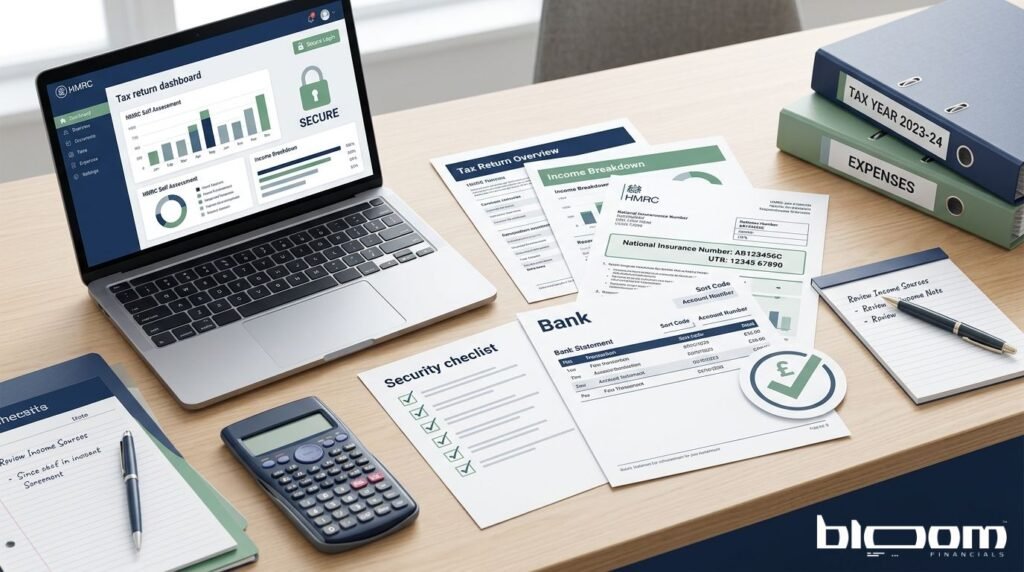
Submitting your Self Assessment tax return can feel like pressing “send” and hoping for the best. One moment, your figures are neatly entered. Next, you are waiting for HMRC to process the return, calculate your tax position, or release a repayment. But behind the scenes, HMRC does not simply accept every return or refund request without review.
Security checks can happen quietly in the background, especially where there is a tax repayment, a new set of bank details, a large CIS refund, unusual expenses, missing PAYE income, or figures that do not match HMRC’s existing records. That does not automatically mean you have done anything wrong. In many cases, HMRC is simply checking that the return is genuine, the taxpayer is the right person, and the repayment is going to the correct place.
For sole traders, landlords, contractors, freelancers, directors, CIS subcontractors and small business owners, understanding these checks can save a lot of stress. It also helps you prepare a stronger, cleaner return before HMRC has a reason to ask questions.
Table of Contents
ToggleShort answer: What checks can HMRC do on a Self Assessment tax return?
HMRC may check your identity, National Insurance number, Unique Taxpayer Reference, Government Gateway access, repayment bank details, previous tax records, PAYE records, CIS deductions, declared income, expenses, rental income, dividends, savings interest and other third-party information. Some repayments may be selected for pre-payment risk checks, detailed security review and manual authorisation before they are issued. HMRC’s own Self Assessment Manual confirms that some repayments can be selected for detailed pre-issue security checks followed by manual authorisation or cancellation.
Why does HMRC check Self Assessment tax returns?
HMRC checks Self Assessment tax returns for four main reasons: to prevent fraud, protect taxpayers, make sure repayments are genuine, and check that the right amount of tax is being paid.
A Self Assessment tax return is not just a form. It is a formal declaration of income, expenses, reliefs and tax due for a tax year. If the return creates a repayment, HMRC also needs to be confident that the refund belongs to the taxpayer and has not been triggered by false information, identity misuse or an incorrect claim.
HMRC has confirmed in its official compliance guidance that it has the right to check whether any tax return is accurate and complete. Its guidance also says it may start a compliance check where figures appear wrong, where a repayment claim looks unusually large compared with the taxpayer’s activity, or where the declared tax seems low compared with turnover.
The scale is not small either. In its 2024 to 2025 annual report, HMRC said it wrote to 243,000 individuals asking them to check and amend Self Assessment returns for previous years where it believed returns were incorrect or missing. It also completed 316,000 compliance checks in 2024 to 2025.
For taxpayers, the key point is simple: a clear, accurate, well-supported tax return is always safer than a rushed one.
What security checks can HMRC carry out?
HMRC does not publish every detail of its internal risk systems, and for obvious reasons, it will not tell taxpayers exactly what triggers every check. However, based on HMRC guidance and normal accounting practice, the following areas are commonly relevant.
Identity checks
HMRC may need to confirm that the person filing the return is genuinely the taxpayer or an authorised agent. This can include checking personal details, Government Gateway access, and identity verification steps.
When using HMRC’s online Self Assessment service, taxpayers may be asked to prove their identity, often using photo ID such as a passport or driving licence. GOV.UK says this is done to keep the taxpayer’s details safe.
National Insurance number and UTR checks
Your National Insurance number and Unique Taxpayer Reference help HMRC link the return to the correct tax record. If personal details, address history, UTR information or agent authorisation do not match, HMRC may pause processing or ask for further confirmation.
This matters particularly for first-time filers, people who have recently moved, taxpayers who have changed their name, and individuals reactivating an old Self Assessment record.
Government Gateway and online account checks
HMRC may look at whether online access appears consistent with normal use. For example, a login from a new device, unusual account activity or a sudden change to repayment details could create extra caution.
This does not mean HMRC is monitoring your personal life. It means the tax account itself must be protected, especially where money could be repaid.
Bank account and repayment destination checks
If your Self Assessment tax return creates a refund, HMRC needs to check where that money is going. A new bank account, changed repayment nominee, duplicate repayment request or mismatch between account details and taxpayer records can all increase the chance of a delay.
HMRC’s Self Assessment Manual states that repayments with draft status may be selected for pre-repayment risk criteria and detailed pre-issue security checks before manual authorisation or cancellation.
PAYE and employment income cross-checks
If you were employed during the tax year, HMRC may compare your declared employment income with PAYE records submitted by your employer. A missing P60, incorrect taxable pay figure, wrong tax deducted figure or omitted employment can lead to a mismatch.
For example, if your P60 shows taxable pay of £32,400 and tax deducted of £4,150, but your return includes only £26,000 of employment income, HMRC may need to understand why.
CIS deduction checks
CIS subcontractors often receive repayments because contractors deduct tax at source before paying them. HMRC may compare CIS deductions claimed on the return with contractor-submitted records.
Example: a subcontractor declares £38,000 gross CIS income and claims £7,600 tax deducted. If HMRC’s records show only £4,400 of deductions, the repayment may be paused until the difference is explained.
Pension, savings, dividend and investment income checks
HMRC can use third-party data to check some income types. For example, HMRC requires UK banks and building societies to submit annual information about interest paid or credited to reportable persons. GOV.UK says this information is used to pre-populate tax accounts and to check that Self Assessment returns are accurate and complete.
Company directors should also take care with dividends. A director who takes £6,000 of dividends from their limited company but forgets to include dividend income on the personal tax return may receive a query later.
Rental income checks
Landlords should expect HMRC to look closely at rental income and property expenses. Rental income, mortgage interest, repairs, letting agent fees, insurance and service charges should be supported by records.
Example: a landlord declares £18,000 of rental income but claims £13,500 of repairs and maintenance in the same year. That may be correct if there was a genuine refurbishment after tenant damage, but the invoices and bank payments should be ready.
Allowable expense pattern checks
HMRC may question expenses that appear too high, too round, personal in nature, or inconsistent with the trade.
Example: a sole trader’s expenses rise from £4,500 to £14,000 year-on-year while turnover stays roughly the same. That may be reasonable if they bought equipment, moved premises or paid subcontractors, but the figures should be supported by receipts, invoices and a clear explanation.
Previous tax year comparison
Your latest tax return does not sit in isolation. HMRC can compare it with previous tax years. Big jumps in income, sudden losses, repeated repayment claims, or sharp changes in expenses may attract attention.
This is why a short note in the “additional information” box can sometimes help. If turnover dropped because a contract ended in October, say so. If expenses increased because you bought a van, keep the invoice and finance agreement.
Third-party data checks
HMRC may compare your return with data from employers, banks, pension providers, platforms, contractors and other sources. The aim is to check whether the return gives a complete picture.
This is particularly relevant for people with mixed income: employment plus freelance work, rental income plus PAYE, CIS plus bank interest, or director salary plus dividends.
Manual repayment authorisation
If a repayment is selected, it may be passed for manual review. That means a person at HMRC may need to authorise or cancel the repayment rather than allowing it to issue automatically.
This can be frustrating, but it is not always a sign of a full enquiry. It may simply be part of HMRC’s repayment security process.
Requests for documents or further evidence
If HMRC needs more information, it may ask for documents such as bank statements, invoices, receipts, CIS statements or proof of identity. GOV.UK says taxpayers need to keep records to complete their tax return correctly, and HMRC may ask for documents if it checks the return.
Is an HMRC security check the same as a tax enquiry?
No. A security check and a tax enquiry are not always the same thing.
A security check often focuses on whether the return, identity or repayment request is genuine. A compliance check, sometimes called a tax enquiry, is more formal and looks at whether the tax position is correct. HMRC’s guidance says a compliance check is when HMRC checks your tax position to make sure you are paying the right tax, receiving the right allowances and reliefs, and that the tax system is operating fairly.
| Type of check | What it means | Common reason | What HMRC may ask for | How serious is it? |
| Routine security check | Background review of identity, account or return details | New filer, changed details, repayment request | Usually, nothing unless something does not match | Usually low concern |
| Repayment security check | HMRC pauses or reviews a refund before paying it | Large refund, new bank details, CIS repayment, unusual pattern | Bank details, CIS records, ID, tax return evidence | Can delay refund, but not always an enquiry |
| Compliance check | HMRC checks whether the return or tax position is correct | Missing income, high expenses, inconsistent figures | Records, invoices, bank statements, calculations | More formal; should be handled carefully |
| Full tax enquiry | Detailed review of the return or wider tax affairs | Serious mismatch, repeated errors, suspected undeclared income | Full business records, explanations, and supporting documents | Higher risk; professional support is strongly advised |
Common reasons HMRC may pause or review a Self Assessment repayment
HMRC may pause or review a repayment for many reasons. Some are simple security issues. Others relate to the figures on the return.
Common triggers include:
- A large CIS refund.
- New or changed repayment bank details.
- A first-time Self Assessment filer.
- A major change in income from the previous tax year.
- Large expense claims.
- Missing PAYE income.
- Rental income that does not match expected figures.
- Dividend income not included.
- Duplicate or unusual repayment requests.
- A tax return filed by an unfamiliar agent.
- Inconsistent personal details.
Here are a few practical examples.
A CIS subcontractor claims a £3,200 repayment after having 20% tax deducted throughout the year. That may be completely legitimate, especially if business expenses reduce taxable profit. But HMRC may still want to match the CIS deductions against contractor records before releasing the refund.
A landlord declares £18,000 of rental income and £12,000 of property expenses. If those costs relate to genuine repairs, agent fees, insurance and mortgage interest, the return may be fine. If the costs are estimates or include capital improvements incorrectly treated as repairs, HMRC may question them.
A company director includes salary but forgets £6,000 of dividends. This is a common mistake, especially where the director thinks “the company has already paid tax”. Corporation Tax and personal tax are different. Dividends received personally must still be considered on the individual’s tax return.
A sole trader’s expenses rise from £4,500 to £14,000 in one year. That could be valid if they bought tools, paid for a van, outsourced work or moved to a bigger workspace. But HMRC may expect the figures to be supported by invoices and bank payments.
What documents might HMRC ask for?
The documents HMRC may ask for depend on the income, expenses or repayment being checked. In practice, taxpayers should be ready to provide:
- Bank statements.
- Sales invoices.
- Purchase invoices.
- Receipts.
- CIS deduction statements.
- P60s and P45s.
- Payslips.
- Dividend vouchers.
- Pension statements.
- Rental agreements.
- Letting agent statements.
- Mortgage interest statements.
- Mileage records.
- Expense breakdowns.
- Proof of identity.
- Proof of address.
- Business records.
- Accounting software reports.
Good records matter because they turn a stressful HMRC letter into a manageable admin task. If your figures are supported, your accountant can usually respond more confidently and clearly.
Record-keeping periods also matter. Self-employed taxpayers must keep business records for at least five years after the 31 January submission deadline for the relevant tax year. For non-business personal tax records, GOV.UK says records should generally be kept for at least 22 months after the end of the tax year if the return is submitted on time.
How long do HMRC security checks take?
There is no single guaranteed timescale. Some checks are resolved quickly. Others take longer, especially where HMRC needs manual review, further evidence, identity confirmation, or information from another department.
The timing can depend on:
- The type of check.
- Whether the repayment needs manual authorisation.
- How quickly the taxpayer replies.
- Whether the documents are complete.
- Whether HMRC needs to compare records.
- Whether an authorised accountant is involved.
- Whether the return contains estimates or missing information.
If you have waited several weeks and your repayment has not moved, it may be worth checking your HMRC online account, contacting HMRC directly, or asking a UK accountant to review the return and any correspondence.
What should you do if HMRC contacts you?
First, do not panic. Second, do not ignore it.
HMRC letters and messages should be treated seriously, but you should also check that the contact is genuine. Scammers often copy HMRC language around refunds and Self Assessment deadlines. HMRC says suspicious emails can be forwarded to phishing@hmrc.gov.uk, suspicious texts to 60599, and scam phone calls can be reported on GOV.UK. HMRC also says it will never send notifications of a tax rebate or ask for personal or payment information by text message.
Take these steps:
- Read the letter or message carefully.
- Check the deadline for replying.
- Do not click links in suspicious emails or texts.
- Log in through GOV.UK directly, not through a message link.
- Gather the documents HMRC has asked for.
- Compare the request with the figures on your tax return.
- Keep copies of everything you send.
- Do not guess or “round off” explanations.
- Ask an accountant to review the return before responding.
- Reply by the stated deadline or request more time if needed.
If the issue relates to a repayment, make sure your bank details, personal details, UTR and National Insurance number are correct.
How Bloom Financials can help
A Self Assessment tax return is easier to defend when it is prepared properly from the start. Bloom Financials helps individuals, sole traders, landlords, directors, contractors, freelancers, CIS subcontractors and small business owners prepare accurate returns with proper records behind the numbers.
That means checking the details before submission, not after HMRC has already raised a concern.
Bloom Financials can help with:
- Preparing accurate Self Assessment tax returns.
- Reviewing income and expense figures before filing.
- Checking PAYE, CIS, rental, dividend and self-employment entries.
- Reducing avoidable errors.
- Organising supporting documents.
- Understanding HMRC letters.
- Communicating with HMRC where authorisation is in place.
- Supporting repayment and security-check situations.
For professional help with Bloom Financials can review your figures, prepare your return, and help you deal with HMRC queries before they become stressful.
Accountant’s checklist before submitting your Self Assessment
Before you submit your tax return, check the basics properly:
- Confirm your UTR and National Insurance number.
- Check all income sources for the tax year.
- Reconcile PAYE income with your P60 or P45.
- Confirm CIS deductions against contractor statements.
- Review bank interest and dividend income.
- Check rental income and allowable property costs.
- Keep receipts, invoices and bank evidence.
- Avoid round-number estimates unless clearly explained.
- Explain unusual changes in income or expenses.
- Check repayment bank details.
- Make sure the return is submitted before the deadline.
- Keep a final copy of the return and tax calculation.
A clean return does not guarantee HMRC will never ask a question, but it puts you in a far better position if they do.
FAQs
Does HMRC check every Self Assessment tax return?
HMRC can check tax returns, but not every return becomes a detailed enquiry. Many checks happen automatically in the background. Some returns may be selected for further review if figures, repayments or personal details do not match HMRC’s records.
Why is my Self Assessment repayment under security checks?
Your repayment may be under security checks because HMRC wants to confirm that the repayment is genuine, the bank details are correct, and the return has not been affected by fraud or incorrect information. Large CIS refunds, changed bank details and first-time filing can all lead to extra checks.
Does a security check mean I am being investigated?
Not always. A repayment security check can be a routine fraud-prevention step. A compliance check or tax enquiry is more formal and focuses on whether your tax return is accurate and complete.
Can HMRC check my bank account?
HMRC may ask you to provide bank statements during a compliance check or to support figures on your return. HMRC also receives certain data from third parties, such as bank and building society interest information, which can be used to check Self Assessment returns.
What happens if my figures do not match HMRC records?
HMRC may ask for an explanation, request documents, delay a repayment, ask you to amend the return, or open a compliance check. Simple mistakes can often be corrected, but missing income or unsupported claims should be handled carefully.
How do I know if an HMRC message is genuine?
Do not rely on a link in an email or text. Log in through GOV.UK directly and check your HMRC online account. Suspicious emails can be forwarded to phishing@hmrc.gov.uk and suspicious texts to 60599.
Can an accountant respond to HMRC for me?
Yes, if proper authorisation is in place. HMRC guidance says that where you use an accountant, HMRC may contact them instead during a compliance check.
Will HMRC still pay my refund after security checks?
If the repayment is valid and HMRC is satisfied with the checks, the refund can still be paid. If HMRC finds an error, the repayment may be reduced, delayed, cancelled or queried further.
What records should I keep after filing?
Keep records that support your income, expenses, tax deducted, reliefs and claims. This can include invoices, receipts, bank statements, CIS statements, P60s, dividend vouchers, rental records and mileage logs.
How can Bloom Financials help with Self Assessment checks?
Bloom Financials can review your tax return, identify possible issues, organise supporting evidence, explain HMRC letters, and help you respond clearly where professional authorisation is in place.
Final thoughts
HMRC security checks are not always bad news. Often, they are there to protect taxpayers, prevent fraud and make sure repayments go to the right person. The problems usually start when figures are guessed, records are missing, income is forgotten or HMRC letters are ignored.
If you are preparing a return, expecting a repayment, or already facing a question from HMRC, Bloom Financials can help you get your records in order, check the figures properly and respond with confidence.
Speak to Bloom Financials before submitting your return, or as soon as HMRC gets in touch.